We are supported by our audience. When you purchase through links on our site, we may earn an affiliate commission, at no extra cost for you. Learn more. Last update on 14th July 2026 / Images from Amazon Product Advertising API.
Budget 3D printers under $500 can save you $300-$2,000 annually, making them worthwhile for hobbyists, educational projects, and rapid prototyping. However, you’ll face layer heights of 0.1-0.3mm versus premium models’ sub-0.1mm precision, build volumes limited to 200×200×200mm, and frequent maintenance issues. Failed prints and material waste from reliability problems can erode initial savings. Your decision depends on balancing upfront affordability against long-term operational costs and performance requirements for your specific applications.
Notable Insights
- Budget 3D printers ($200-500) can save $300-2,000 annually by enabling DIY repairs and prototypes instead of purchasing items.
- Cheap printers excel at rapid design iterations and STEM education but suffer from resolution limitations and visible layer lines.
- Hidden costs include material waste from failed prints, frequent part replacements, and ongoing maintenance that may exceed initial savings.
- Build volume restrictions around 200×200×200 mm require splitting larger models into multiple parts, limiting production capabilities significantly.
- Professional applications may require investing in durable equipment, as productivity losses from budget printers could outweigh cost savings.
Understanding the Current 3D Printing Market Landscape
Why has 3D printing suddenly become such a dominant force in manufacturing? Market trends reveal explosive growth patterns you can’t ignore.
The global market reached $24–29 billion in 2024, with industry projections showing expansion to $101–135 billion by 2032. That’s a 17% to 23% annual growth rate.
You’ll find North America leading with 32% to 41% market share, while Asia-Pacific emerges as the fastest-growing region. Post-COVID supply chain disruptions accelerated adoption rates considerably.
Manufacturing sectors like automotive, aerospace, and healthcare drive this expansion through digital integration with Industry 4.0 frameworks. The prototyping sector dominates with approximately 55% of total revenues, making it the largest application segment across industries.
Technology segmentation includes FDM, SLA, and SLS printer types using materials from basic plastics to advanced bio-materials. Stereolithography technology currently accounts for the highest revenue share in the 3D printing market.
However, you should note barriers exist: high initial costs, supply chain volatility, and intellectual property concerns still challenge widespread adoption.
Key Advantages of Budget-Friendly 3D Printers
Budget-friendly 3D printers deliver compelling financial advantages that make additive manufacturing accessible to individual users and small businesses. You’ll save $300 to $2,000 annually by printing household items instead of purchasing replacements.
These machines excel as prototyping tools, enabling rapid design iterations without expensive tooling or molds. The democratization extends beyond cost savings. You gain access to creative projects previously requiring industrial equipment, while repair solutions become immediately available through downloadable designs.
Educational opportunities flourish as budget printers teach manufacturing fundamentals in classrooms and homes. Community support networks actively assist troubleshooting and skill development. A single operator manages multiple printers, reducing labor costs considerably.
The additive process minimizes material waste since filament deposits only where needed, cutting production expenses while enabling complex geometries impossible through traditional manufacturing methods. Budget models typically range from $200-$500 and often include starter kits with essential accessories to maximize value for new users. These affordable options encourage experimentation among amateur and professional users alike, fostering growth within communities. Popular entry-level models like the Creality Ender 3 feature resume printing functions that recover from power loss or errors, making them ideal for beginners due to strong community support. Despite material limitations, these printers effectively handle most home solutions and small-scale production needs. For complex detailed work requiring exceptional print quality, users may need to consider upgrading to higher-resolution systems with advanced features.
Common Limitations and Potential Risks to Consider
While budget printers offer compelling advantages, they come with significant technological constraints that can frustrate users and limit practical applications.
You’ll encounter resolution limitations that produce visible layer lines and rough surface finishes. Most cheap printers use basic FDM technology, restricting precision to levels unsuitable for demanding prototypes requiring sub-0.1mm accuracy.
User experience suffers from reliability issues. Fragile components break frequently, requiring constant manual calibration. User reviews consistently highlight maintenance challenges that reduce operational efficiency through frequent downtimes and failed prints.
Budget printers demand constant attention with fragile parts breaking regularly and calibration issues causing frequent print failures and operational downtime.
Material compatibility remains severely limited. You can’t use high-performance filaments or specialty composites due to inadequate thermal control systems. Print speeds are significantly slower, making production scaling impractical.
Hidden costs accumulate through repairs, repeated prints, and material waste, potentially exceeding initial savings.
Ideal Applications for Entry-Level 3D Printers
Five distinct application categories make entry-level 3D printers valuable investments despite their technical limitations.
You’ll find educational tools applications excel in STEM environments, where students learn design principles through hands-on manufacturing processes. PLA and ABS materials enable rapid design iterations for mechanical prototypes, letting you validate concepts without expensive tooling costs.
Functional prototypes emerge as another strength. You can produce brackets, enclosures, and jigs using polycarbonate or ABS filaments for moderate-strength applications. Electronics housings and DIY project components represent common use cases. Auto bed leveling prevents common issues like warping during longer prototype prints, improving success rates for functional parts.
Artistic expressions flourish through detailed miniatures, jewelry, and decorative items. Entry-level precision capabilities support complex geometries unachievable through traditional manufacturing. For terrain modeling applications, PLA and PETG materials provide the durability and compatibility needed for detailed tabletop gaming pieces. Premium filaments with ±0.02mm accuracy ensure intricate miniature details remain sharp and properly proportioned.
Finally, DIY repairs extend product lifecycles. You’ll create replacement parts for household items and obsolete components, reducing commercial vendor dependencies while maintaining cost-effectiveness. While resin printers deliver superior detail for miniature applications, entry-level FDM models provide adequate quality for most hobbyist and educational purposes.
Evaluating Cost Vs Performance Trade-Offs
When you’re considering a budget 3D printer, you’ll face clear trade-offs between initial savings and performance limitations that directly impact your printing experience.
Your $185 Elegoo Mars 3 Pro delivers impressive 4K resolution for miniatures but restricts you to small build volumes.
Meanwhile, sub-$500 FDM printers often cap print speeds around 200-300 mm/s compared to higher-end models reaching 500+ mm/s.
Beyond the upfront cost, you’ll need to factor in ongoing expenses like frequent calibration, material costs, and potential upgrades that can push your total investment well beyond the initial purchase price.
Build Volume Limitations
Build volume stands as one of the most considerable limiting factors you’ll encounter with budget 3D printers, directly impacting what you can create and how you’ll approach your projects.
Most cheap desktop FDM printers offer build volume dimensions around 200×200×200 mm, restricting your printing capabilities to smaller objects. You’ll need to split larger models into multiple parts for assembly if they exceed these boundaries.
Professional printers provide build volumes exceeding 500 mm per axis, but cost considerably more.
Budget printer frames lack the rigidity for larger print areas without compromising precision. You’ll face mechanical constraints from cheaper linear rails, smaller motors, and lighter construction.
These limitations force careful project planning and design modifications to fit within volume boundaries.
Print Quality Differences
The gap between cheap and expensive 3D printers becomes most apparent in print quality, where you’ll face distinct performance trade-offs that directly impact your project outcomes.
Budget FDM printers typically achieve layer heights between 0.1mm and 0.3mm, while premium models print below 0.1mm for superior detail fidelity. Poor extrusion control in low-cost machines creates visible layering artifacts and rougher surface finish without post-processing.
You’ll encounter stringing, small blobs, and inconsistent extrusion on complex geometries. However, entry-level resin printers like the Elegoo Mars 3 Pro ($185) deliver exceptional detail through 4K LCD screens.
Budget printer performance heavily depends on calibration-default settings produce noticeably inferior results. With proper tuning, you can achieve respectable print quality, though it requires significant time investment.
Long-Term Operational Costs
Beyond initial purchase price, cheap 3D printers often carry hidden operational costs that can exceed your upfront savings within the first year of regular use.
Material waste from failed prints greatly impacts cost efficiency, especially when using specialized filaments costing $50+ per kilogram. Entry-level printers require frequent part replacements: build plates ($25-$100), nozzles ($10-$50), and consumable components like belts and heating elements.
Your usage frequency directly affects these expenses. High-volume printing accelerates wear on critical components, while longer print cycles on budget printers increase electricity consumption.
Labor costs compound the problem, with troubleshooting and calibration requiring $15-$60 per hour in skilled intervention. Failed prints force reprinting, doubling material and energy costs while reducing overall productivity and operational efficiency.
Additionally, budget printers often lack proper vibration dampening features, leading to poor print quality and increased material waste compared to setups with heavy-duty metal constructions and solid wood tops.
Build Volume and Technical Specifications Reality Check
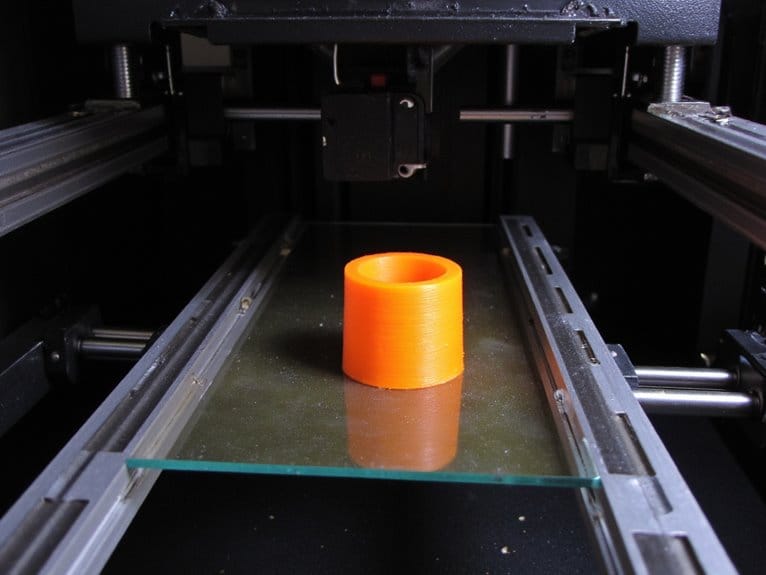
When evaluating cheap 3D printers, you’ll find that manufacturers often advertise impressive build volumes and specifications that don’t always translate to real-world performance.
Build volume comparisons reveal budget FDM printers typically offer 220 x 220 x 250 mm to 300 x 300 x 400 mm. The Sovol SV06 Ace provides 220 x 220 x 250 mm, while the Artillery Sidewinder X2 delivers 300 x 300 x 400 mm.
Technical specifications analysis shows resin printers have smaller volumes, like the Anycubic Mono X 6K at 245 x 197 x 122 mm.
Budget printers sacrifice quality for larger volumes. You’ll encounter heated bed limits of 110-120℃, restricting material compatibility beyond PLA and PETG.
Mechanical components often lack precision, requiring frequent adjustments and limiting print consistency across the full advertised build volume.
Material Compatibility and Long-term Operational Costs
While cheap 3D printers offer attractive entry points into additive manufacturing, they impose significant material restrictions that directly impact long-term operational costs.
Your material selection becomes severely limited to basic filaments like PLA and occasionally ABS. Printer limitations prevent you from utilizing advanced materials such as PETG, Nylon, or carbon fiber composites that require precise temperature control.
These restrictions affect filament durability and operational efficiency. You’ll face increased maintenance costs when attempting abrasive materials on inadequate hardware.
Printing challenges multiply with poor adhesion and warping, creating substantial material waste. Budget printers lack heated beds and robust extruders necessary for reliable performance consistency.
The hidden cost emerges through repeated print failures, component wear, and inability to access stronger materials for demanding applications.
Making the Right Decision for Your Specific Needs
Your decision to buy a cheap 3D printer shouldn’t be based on price alone – it requires careful analysis of your budget limits, project needs, and future plans.
Start by setting a realistic spending cap that includes not just the printer cost but also filament, replacement parts, and potential upgrades over the next 2-3 years.
Next, clearly define what you’ll actually print, from simple prototypes requiring ±0.5mm tolerances to detailed miniatures needing layer heights below 0.2mm.
These requirements will determine whether a $200 printer can meet your standards or if you’ll need something more capable.
Budget approximately 20% of your annual revenue for operating expenses including electricity costs, which can range from 50 to 300 watts depending on the model you choose.
Consider whether you’ll need dual extruder capabilities for multi-material printing or complex geometries with soluble supports, as this advanced functionality typically comes at a higher price point but opens up significantly more creative possibilities.
Assess Your Budget Constraints
How much can you realistically spend on a 3D printer without stretching your finances too thin? Your budget limitations directly determine which features you’ll access and what compromises you’ll make.
Entry-level FDM printers start around $200-$300, with basic models like the Creality Ender-3 available for $189. However, your initial investment often increases when adding essential upgrades.
Resin printers offer an alternative at $145-$185, providing high resolution but smaller build volumes.
You’ll face ongoing costs beyond the printer itself. Filament spools average $20-$30, while maintenance parts require periodic replacement. Cheaper models typically demand more frequent servicing, increasing long-term expenses.
Consider your total budget including materials, upgrades, and maintenance. Budget printers excel for beginners and hobbyists but may frustrate users requiring professional-grade consistency and advanced features.
Define Project Requirements
Before purchasing any 3D printer, you must clearly define what you’ll actually create with it. Your project requirements directly determine which printer features you’ll need and greatly impact your user experience.
Consider object size limitations first. Small decorative items need minimal build volume, while functional prototypes require larger platforms. Material compatibility matters equally-PLA works for basic models, but engineering applications demand ABS or PETG capabilities.
Evaluate precision requirements carefully. Miniature figures need 0.1mm layer resolution, while functional brackets can use 0.3mm layers effectively. Moving parts require specific tolerances-typically 0.2-0.4mm clearance between components.
Surface finish expectations also matter. Visible parts need superior quality, requiring enclosed chambers and heated beds. Prototype components can accept visible layer lines without compromising functionality.
Evaluate Long-Term Goals
While defining project requirements establishes your immediate needs, evaluating long-term goals determines whether a cheap 3D printer will serve you effectively over time. Future planning requires analyzing your projected usage patterns and technological needs.
Cheap printers typically last 3-5 years with balanced usage, while industrial-grade models can operate for decades. Your user expectations must align with maintenance realities-budget models need frequent repairs and manual adjustments that impact productivity.
Consider whether you’ll expand into advanced materials or higher-volume production. Cheap printers often lack firmware update support, limiting adaptability to new technologies.
If you’re planning professional applications or skill development, investing in upgradeable hardware with community support guarantees sustained utility. Evaluate replacement part availability and costs, as cheap components create higher cumulative maintenance expenses over time.
On a final note
You’ll find cheap 3D printers worthwhile if you’re starting out or working on basic prototypes. They’re perfect for learning fundamentals without major investment. However, don’t expect professional-grade results or reliability. Budget models typically offer 0.1-0.2mm layer resolution and smaller build volumes around 150-200mm³. You’ll spend extra time on calibration and maintenance. If you need precision parts or plan heavy usage, invest in mid-range options. For hobbyists and educators, they’re absolutely worth it.