We are supported by our audience. When you purchase through links on our site, we may earn an affiliate commission, at no extra cost for you. Learn more. Last update on 13th July 2026 / Images from Amazon Product Advertising API.
PLA is better if you’re starting out or need easy printing with superior surface quality, operating at lower temperatures (190-210°C) without requiring enclosures. ABS excels when you need durability and heat resistance up to 105°C, though it demands higher printing temperatures (220-260°C) and proper ventilation due to toxic fumes. Your choice depends on whether you prioritize ease-of-use and detail (PLA) or mechanical strength and temperature tolerance (ABS). Understanding each material’s specific properties will help you make the best selection for your projects.
Notable Insights
- PLA is easier to print with lower temperatures (190-210°C) and no enclosure needed, while ABS requires higher temperatures and controlled environments.
- PLA offers better surface finish and dimensional accuracy with minimal warping, making it ideal for detailed prototypes and decorative items.
- ABS provides superior impact resistance and heat tolerance up to 105°C, making it better for functional parts and automotive applications.
- PLA is more environmentally friendly, being biodegradable and made from renewable sources, while ABS is petroleum-based and non-biodegradable.
- ABS emits more harmful fumes requiring ventilation, while PLA is safer to print indoors with minimal odor and toxicity concerns.
Printing Difficulty and Temperature Requirements
When choosing between PLA and ABS for your 3D printing projects, temperature requirements represent the most fundamental difference that’ll impact your printing success. PLA operates at lower extruder temperatures between 190-210°C, while ABS demands higher heat ranging from 220-260°C.
This temperature gap affects your entire workflow. PLA’s forgiving nature allows easier printing settings without strict environmental controls. You won’t need an enclosure, and bed temperatures of 40-60°C suffice.
ABS requires precise temperature tuning with heated beds at 90-110°C and enclosed printing environments. Most hobby printers handle both materials, but ABS’s stringent requirements increase setup complexity. The cooling requirements also differ significantly, with PLA benefiting from 100% cooling while ABS performs better without active cooling. ABS benefits from an enclosure that provides uniform cooling throughout the printing process.
Small 5-10°C adjustments help optimize performance for either material, though PLA tolerates variations better.
Strength Characteristics and Mechanical Performance
When you’re choosing between PLA and ABS for functional parts, you’ll need to understand how these materials perform under different types of mechanical stress.
PLA delivers higher tensile strength at 50-60 MPa compared to ABS’s 30-36 MPa, but this advantage disappears when you consider impact resistance and flexibility.
ABS compensates for its lower tensile strength with roughly four times better impact resistance and 11% elongation at break versus PLA’s brittle 4%, making material selection dependent on whether you prioritize rigid strength or dynamic toughness. The materials also differ significantly in their flexural modulus, with PLA being nearly three times stiffer at approximately 3,800 MPa compared to ABS’s 1,350 MPa.
Tensile Vs Impact Strength
Strength characteristics reveal a fascinating trade-off between PLA and ABS that’ll directly impact your 3D printing project success.
When you’re choosing between these materials, understanding tensile strength versus impact strength becomes essential for application-specific decisions.
PLA delivers superior tensile strength at 50-60 MPa compared to ABS’s 27-32 MPa, making it better for withstanding pulling forces. However, ABS dominates impact strength with 200-215 J/m versus PLA’s modest 96 J/m.
Key strength differences include:
- Tensile performance: PLA offers nearly double ABS’s resistance to pulling forces
- Impact resistance: ABS withstands sudden shocks considerably better than brittle PLA
- Elongation capacity: ABS stretches up to 50% while PLA breaks at just 4-6%
- Environmental stability: ABS maintains strength under stress; PLA degrades with temperature exposure
Flexibility and Durability Differences
Beyond raw strength measurements, flexibility and durability characteristics create the most decisive performance gap between PLA and ABS for real-world applications.
Your flexibility comparison reveals ABS’s clear advantage with 11% elongation at break versus PLA’s mere 4%. ABS’s lower flexural modulus of 1,350 MPa makes it less stiff than PLA’s 3,800 MPa, allowing better stress absorption without cracking.
For durability analysis, ABS demonstrates superior impact resistance with 200-215 J/m compared to PLA’s 96.1 J/m.
ABS maintains structural integrity up to 105°C while PLA fails at 55-60°C. You’ll find ABS resists UV degradation, chemicals, and abrasion better than PLA.
However, PLA’s biodegradable nature limits long-term mechanical stability compared to ABS’s petroleum-based durability.
Heat Resistance and Environmental Durability
When you’re choosing between PLA and ABS for applications involving heat or outdoor environments, you’ll find significant performance differences that can make or break your project.
ABS maintains its structural integrity at temperatures up to 96–105°C, while PLA begins softening around 55–60°C, making it unsuitable for anything exposed to warm conditions like car interiors or outdoor summer use.
Your material choice becomes even more critical when considering long-term outdoor exposure, since ABS offers moderate UV resistance and superior impact strength at 200–215 J/m compared to PLA’s poor UV performance and brittle 96 J/m impact rating.
Temperature Tolerance Comparison
Temperature tolerance represents one of the most critical differences between PLA and ABS filaments, directly affecting both printing requirements and final part performance.
Understanding their thermal characteristics helps you select the right material for your specific application needs.
Key Temperature Differences:
- Working Temperature – PLA operates up to 52°C while ABS handles 98-105°C, nearly doubling heat capacity.
- Temperature Range – PLA prints at 190-220°C versus ABS’s demanding 220-250°C requirement.
- Heat Resistance – ABS maintains structural integrity under thermal stress; PLA deforms above 60°C.
- Cooling Efficiency – PLA requires maximum cooling for detail; ABS needs minimal cooling to prevent warping.
You’ll find ABS superior for automotive parts, outdoor applications, or heated environments.
PLA works best for decorative items, prototypes, and room-temperature applications where thermal exposure isn’t a concern.
Outdoor Application Suitability
Real-world outdoor applications expose 3D printed parts to harsh environmental conditions that quickly separate robust materials from fragile ones.
PLA’s poor UV resistance causes rapid degradation and brittleness during outdoor exposure, while its moisture absorption weakens prints considerably.
You’ll find ABS offers superior weather resistance with its hydrophobic properties and better chemical resistance.
ASA provides even greater filament longevity, delivering ten times better UV resistance than ABS for extended outdoor use.
ABS’s impact resistance and ductility handle temperature cycling and mechanical stresses effectively, while PLA’s brittleness leads to cracking under outdoor conditions.
For functional outdoor components, ABS maintains structural integrity through environmental thermal fluctuations.
PLA softens easily in heat, causing warping and dimensional instability that compromises long-term performance.
Sustainability and Material Origins
Although both PLA and ABS serve identical functions in 3D printing applications, their environmental impacts differ dramatically due to fundamental differences in material origins and production processes.
PLA’s sustainable sourcing from renewable plant resources like corn starch creates a considerably smaller ecological footprint compared to ABS’s petroleum-based manufacturing.
You’ll find that PLA production consumes less energy and generates fewer greenhouse gas emissions during both manufacturing and printing operations.
Key sustainability differences include:
- Material origins – PLA derives from renewable plants while ABS uses finite fossil fuels
- Production emissions – PLA generates lower carbon footprint during manufacturing
- End-of-life impact – PLA biodegrades in industrial composting; ABS persists indefinitely
- Energy consumption – PLA requires lower processing temperatures, reducing operational costs
However, PLA’s sustainability depends on available composting infrastructure and potential competition with food crop resources.
Surface Finish and Precision Capabilities
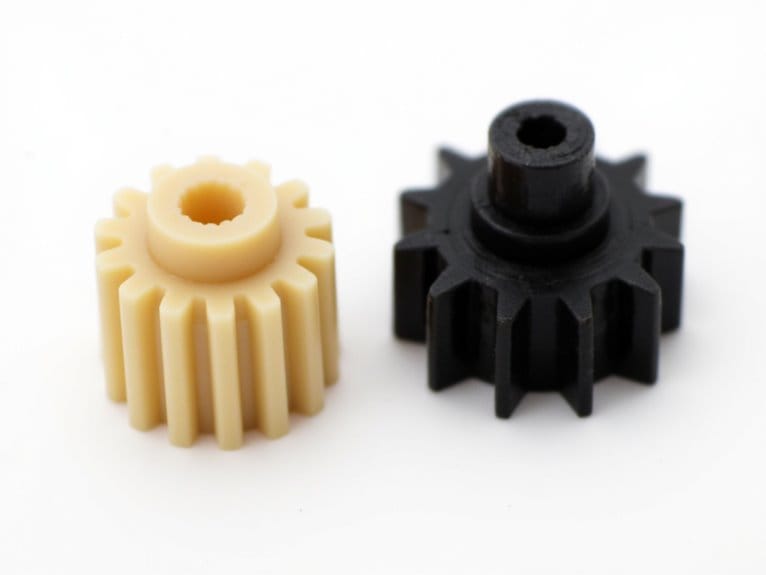
Beyond environmental considerations, the visual quality and dimensional accuracy of your printed parts represent critical factors when selecting between PLA and ABS filaments.
PLA delivers superior print quality straight from the printer, producing smooth, glossy surfaces ideal for display models. You’ll achieve dimensional accuracy within 0.5mm tolerances and minimum 1-2mm wall thicknesses with both materials. However, PLA’s lower printing temperatures (160-220°C) reduce warping risks, enabling better precision for intricate features.
ABS initially exhibits rougher surface texture and matte finishes requiring post-processing. Yet this material offers greater flexibility for mechanical finishing operations without detail damage. Acetone vapor smoothing transforms ABS surfaces into glossy finishes.
While ABS demands heated beds and higher temperatures (210-250°C), its post-processing capabilities ultimately provide enhanced surface customization options.
Most high-quality filaments ensure dimensional accuracy of +/- 0.02mm, which significantly improves the precision of both PLA and ABS prints when proper printing conditions are maintained.
Workplace Safety and Fume Considerations
When selecting between PLA and ABS filaments, you must consider the significant differences in their emission profiles and potential health impacts during printing. ABS emits substantially higher levels of ultrafine particles and volatile organic compounds compared to PLA. These emissions pose respiratory and cardiovascular risks with chronic exposure.
Essential workplace safety measures include:
- Install ventilated enclosures with HEPA and activated carbon filtration for ABS printing.
- Monitor particle and VOC concentrations regularly to assess exposure levels.
- Implement respiratory protection when printing ABS in poorly ventilated areas.
- Use PLA for frequent printing to minimize fume toxicity risks.
Both materials release formaldehyde and styrene during heating. Effective emission control requires more than natural room ventilation, especially for ABS applications.
Best Applications for Each Filament Type
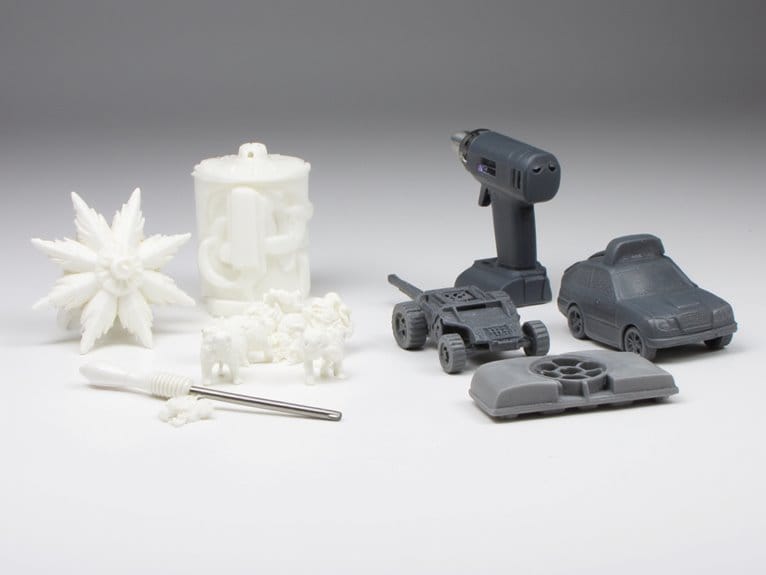
Each filament type excels in distinct applications based on its unique material properties and performance characteristics.
You’ll find PLA ideal for food packaging, decorative household items, and biomedical applications like surgical guides and tissue scaffolds. Its FDA approval and biodegradability make it perfect for containers, cups, and sustainable packaging solutions. Design considerations favor PLA for detailed prototypes and consumer electronics due to minimal warping.
ABS performs better in automotive interior components, safety helmets, and structural parts requiring impact resistance. Its higher temperature tolerance suits applications exposed to heat stress.
Filament longevity becomes essential when choosing between materials-PLA degrades naturally while ABS maintains structural integrity longer under mechanical stress.
Select PLA for short-term, decorative, or biocompatible applications. Choose ABS for durable, functional parts requiring mechanical strength and temperature resistance.
On a final note
You’ll find PLA excels for beginners due to its 190-220°C printing temperature and minimal warping. However, ABS offers superior strength with 4,700 psi tensile strength versus PLA’s 3,900 psi. Choose PLA when you’re prioritizing ease of use, biodegradability, and detailed prints. Select ABS if you need heat resistance above 60°C or mechanical durability. Your specific application requirements-not universal superiority-should determine your filament choice.