We are supported by our audience. When you purchase through links on our site, we may earn an affiliate commission, at no extra cost for you. Learn more. Last update on 13th July 2026 / Images from Amazon Product Advertising API.
Most 3D printers use PLA filament, which accounts for 60-70% of consumer purchases due to its beginner-friendly properties. You’ll find PLA prints reliably at 180-205°C without requiring a heated bed, making it compatible with nearly all desktop FDM printers. ABS serves as the industrial standard for durability, while PETG offers versatile performance between PLA’s ease and ABS’s strength. Each material targets specific applications based on your project’s temperature, strength, and printing requirements that we’ll explore further.
Notable Insights
- PLA is the most widely used filament due to its beginner-friendly properties and compatibility with nearly all FDM printers.
- ABS remains popular for industrial applications requiring durability, heat resistance, and mechanical strength in production environments.
- PETG serves as a versatile middle-ground option, combining PLA’s ease of printing with ABS-like mechanical performance.
- Most consumer 3D printers are designed primarily for PLA printing, requiring no heated bed or specialized ventilation systems.
- Specialized filaments like nylon and carbon fiber composites are growing but require specific printer modifications and expertise.
PLA: The Most Popular Choice for Desktop 3D Printing
When you’re starting out in 3D printing, PLA (Polylactic Acid) stands as the most widely adopted filament for desktop printers worldwide.
This thermoplastic derives from renewable resources like corn starch and sugarcane. You’ll find PLA prints at lower temperatures (180-205°C) without requiring a heated bed, making it incredibly beginner-friendly.
The PLA benefits include minimal warping, excellent dimensional accuracy, and odorless printing suitable for indoor environments.
It’s available in extensive color options and works with nearly all FDM printers. You can easily remove supports and achieve clean finishes. For enhanced precision work, PRO Series PLA offers a precise diameter tolerance of 0.02mm for high-caliber printing applications.
However, PLA limitations include brittleness compared to ABS and poor heat resistance above 60°C.
It’s unsuitable for high-stress mechanical applications or high-temperature environments, making it ideal primarily for prototypes and decorative items. PLA’s biodegradable properties make it an environmentally conscious choice that produces non-toxic byproducts when disposed of properly.
ABS: The Industrial Standard for Durable Applications
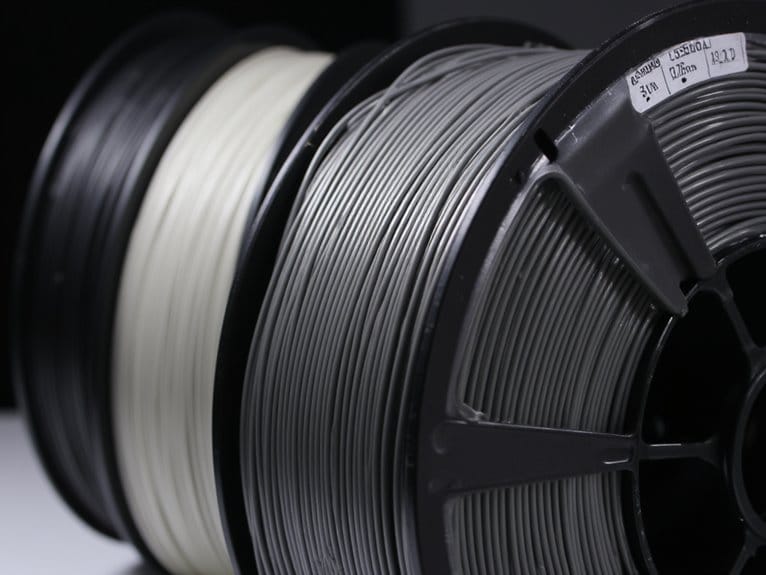
While PLA dominates beginner-friendly applications, ABS (acrylonitrile butadiene styrene) serves as the backbone for industrial and demanding consumer applications where durability trumps ease of printing.
You’ll find ABS advantages in its superior impact resistance, chemical resilience, and higher temperature tolerance compared to PLA. The three-monomer composition delivers exceptional toughness-acrylonitrile provides structural rigidity, butadiene adds impact strength, and styrene guarantees smooth surface finishes.
However, ABS limitations include warping tendencies and printing complexity. You’ll need heated beds, controlled chamber temperatures, and proper ventilation due to slight odor emissions. ABS is not soluble in most substances but can be dissolved in acetone for effective post-processing applications.
ABS demands technical precision-heated beds, temperature control, and ventilation-making it challenging for beginners despite superior durability.
LEGO’s 60-year commitment to ABS demonstrates its proven durability. Industrial applications span automotive dashboards, aerospace components, and electronics housings. Carbon fiber-reinforced variants further enhance strength for high-performance parts, though they require hardened steel nozzles.
PETG: Growing Popularity as a Versatile Alternative
As 3D printing technology matures beyond hobbyist applications, PETG (polyethylene terephthalate glycol) has emerged as the compromise filament that bridges PLA’s ease of use with ABS’s mechanical performance.
You’ll find PETG benefits include superior impact resistance, chemical stability, and minimal warping during printing. The material prints reliably on most FDM printers without requiring heated enclosures.
PETG applications span multiple industries:
- Healthcare devices – Medical prototypes and production parts requiring biocompatibility
- Automotive components – Custom tools and testing fixtures demanding mechanical strength
- Consumer products – Transparent containers and protective enclosures with glossy finishes
- Aerospace prototyping – Functional parts requiring thermal stability and precision geometries
Carbon fiber-reinforced PETG variants offer enhanced stiffness with tensile modulus reaching 3800 MPa, making them ideal for load-bearing applications requiring both strength and aesthetic appeal.
Specialized Filaments: Nylon, Carbon Fiber, and Beyond
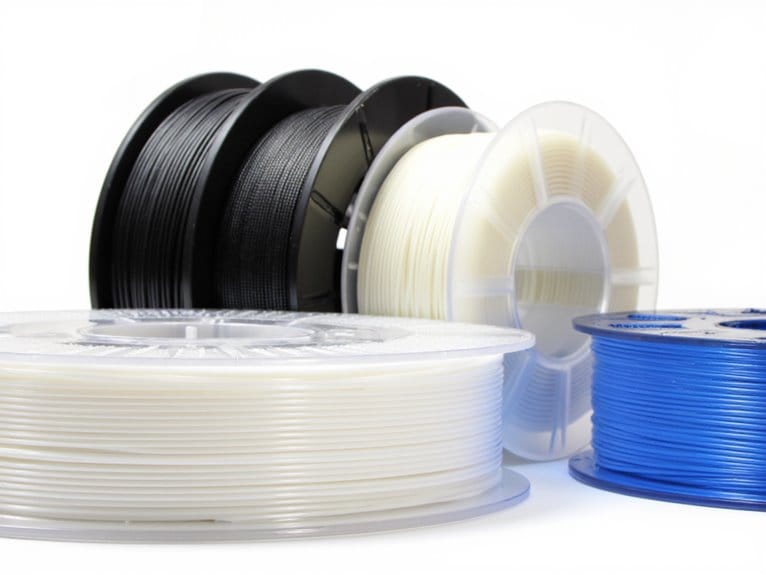
Beyond mainstream materials, specialized filaments reveal advanced manufacturing capabilities that transform 3D printing from prototyping into production-grade tooling.
Nylon advantages include exceptional impact resistance and durability, with NylonG delivering 33% greater strength than NylonX. You’ll need extruder temperatures around 245±15°C and bed temperatures of 60±10°C for ideal results.
NylonG’s superior 33% strength advantage over NylonX makes it ideal for impact-resistant applications requiring exceptional durability.
Carbon fiber applications extend to structural components requiring high stiffness-to-weight ratios. These composites resist deformation while maintaining dimensional accuracy.
You can create drone bodies, tooling molds, and stress-bearing parts directly from your printer.
Specialty options include MoldLay for investment casting at 175°C, TPU for flexible seals, and continuous fiber composites.
These materials require hardened nozzles and specific build surfaces like Garolite for successful printing.
Choosing the Right Filament for Your Printing Needs
Which filament should you choose when your printer supports multiple materials? Start by evaluating your project’s requirements against filament properties.
PLA remains ideal for beginners, printing at 180-230°C extrusion temperatures without heated beds. Its ease of use makes it perfect for prototypes and decorative items.
Consider these key selection factors:
- Heat resistance needs – PLA fails at 60°C, while ABS withstands higher temperatures
- Printer capabilities – Entry-level machines often can’t reach ABS’s 220-250°C requirements
- Ventilation availability – ABS fumes demand proper airflow, unlike odorless PLA
- Project durability – Functional parts need ABS or PETG strength over PLA’s brittleness
PETG offers middle-ground versatility with ABS-like strength but PLA-like printability. Look for filaments with dimensional accuracy of +/- 0.02mm to ensure consistent print quality and reliable performance.
For applications requiring exceptional durability and impact resistance, nylon filament provides 10x the toughness of standard PLA, though it demands precise temperature control and moisture management.
Vacuum-sealed packaging protects filaments from moisture damage that can compromise print quality and cause stringing or bubbling during extrusion.
Match your printer’s specifications with material demands for best results.
On a final note
You’ll find PLA dominates desktop 3D printing due to its ease of use and low printing temperatures of 190-220°C. However, your specific application determines the best choice. If you need durability, ABS works better despite requiring heated beds at 80-110°C. PETG offers chemical resistance with easier printing than ABS. Consider your printer’s capabilities, required mechanical properties, and environmental conditions. Match filament specifications to your project requirements rather than defaulting to popularity.