We are supported by our audience. When you purchase through links on our site, we may earn an affiliate commission, at no extra cost for you. Learn more. Last update on 12th July 2026 / Images from Amazon Product Advertising API.
3D printing costs vary dramatically based on your needs and equipment choice. You’ll spend $100-$400 for entry-level printers like the Creality Ender 3, while professional systems start at $1,000 and industrial models exceed $100,000. Material expenses range from $15/kg for basic PLA to $500/kg for specialty filaments like PEEK. Hidden costs include maintenance, energy consumption, failed prints, and post-processing labor that can double your initial budget estimates. Understanding these thorough factors will help you make informed investment decisions.
Notable Insights
- Entry-level 3D printers cost $100-$400, while basic PLA filament starts at $10-15 per kilogram for hobbyist use.
- Material costs vary dramatically from $15/kg for basic PLA to $400-500/kg for specialty high-performance filaments like PEEK.
- Hidden expenses including failed prints, maintenance, energy consumption, and post-processing can double initial budget estimates.
- Complex geometries and finer layer settings increase print times by 300-500%, significantly raising per-part operational costs.
- Professional setups require substantial investment but high-quality printers reduce failures and long-term operating expenses over time.
Equipment and Setup Investment Requirements
Three main price tiers define the 3D printer market, each targeting different user needs and budgets. Entry-level models cost $100-$400, perfect for beginners exploring basic printing capabilities. The Creality Ender 3 series ($200-$220) and Elegoo Centauri Carbon ($299) exemplify quality budget options.
Mid-range printers ($400-$1,000) offer enhanced precision for serious hobbyists, while professional machines start at $1,000 and can reach tens of thousands. The print technology you choose, whether FDM, SLA, or SLS, significantly influences the overall equipment cost.
Beyond the printer itself, you’ll face additional setup expenses. Kit assembly can reduce upfront costs but demands technical skills and time investment.
Workspace preparation requires ventilation systems, stable surfaces, and safety equipment like smoke detectors. Essential accessories include replacement nozzles, bed surfaces, filament holders, and calibration tools. High-end resin printers may require specialized accessories that can significantly increase initial setup costs for complete printing solutions.
These supplementary components add incremental costs that greatly impact your total initial investment. Many modern printers feature auto leveling capabilities that simplify setup and reduce long-term maintenance costs. Regular maintenance is essential for printer longevity and optimal performance throughout your 3D printing journey.
Material Costs and Selection Impact
Your material choices dramatically affect your 3D printing costs, with basic PLA filament starting at $10 per kilogram while specialty materials like PEEK can reach $400 per kilogram.
You’ll also need to factor in how long each print takes, since longer print times consume more material and electricity, directly impacting your per-part costs.
Smart material selection and waste reduction techniques can greatly lower your overall printing expenses, especially when you’re producing multiple parts or prototypes. Don’t forget that additional costs like filament dryers, storage solutions, and adhesives can add $120 to $390 to your initial setup budget.
Material Type Price Differences
Material selection dramatically affects your 3D printing costs, with price differences spanning from budget-friendly options at $15 per kilogram to premium specialty materials exceeding $500 per kilogram.
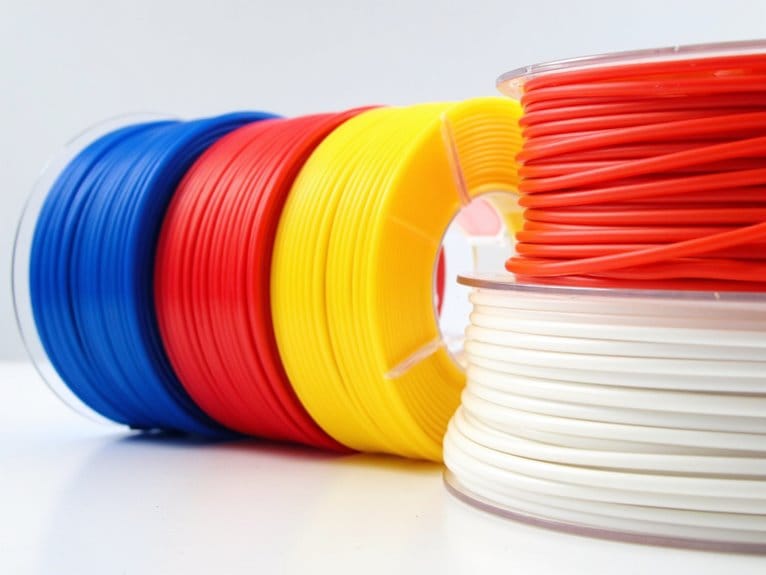
Your filament comparison starts with PLA at $15-40 per kilogram, making it ideal for beginners. ABS costs $20-50 per kilogram with broader applications. PETG ranges $20-60 per kilogram, offering durability without complexity. TPU flexible filament jumps to $40-100 per kilogram due to specialized formulations.
Price analysis reveals dramatic increases for specialty materials. PEEK and composite filaments reach $400-500 per kilogram, reflecting their high-performance properties and complex manufacturing processes.
- Standard materials (PLA, ABS, PETG) provide 3-4x cost differences based on mechanical properties.
- Flexible and composite filaments cost 2-10x more than basic materials due to specialized additives.
- Specialty resins for SLA printing span $40-200 per kilogram depending on chemical formulation complexity.
Quality brands like FLASHFORGE, Creality, and SUNLU maintain dimensional accuracy of +/- 0.02mm while keeping costs competitive within their respective material categories.
Print Time Cost Factors
Print duration directly multiplies your operational expenses beyond material selection, creating compound cost effects that can double or triple project budgets.
Complex geometries with fine details extend print times by 300-500% compared to simple shapes. Your layer height settings create significant print duration implications-0.1mm layers take three times longer than 0.3mm layers but deliver superior surface finish.
Material choice compounds these effects. Flexible filaments require 40-60% slower speeds than PLA, while specialty materials need extended heating cycles. Higher infill percentages from 20% to 80% can triple material usage and print time simultaneously.
Scheduling optimization becomes critical for cost control. Longer prints increase failure risks and equipment downtime. Fast printers cost more upfront but reduce per-part expenses through improved throughput and energy efficiency.
Waste Reduction Strategies
Strategic waste reduction can slash your 3D printing material costs by 60-90% while protecting your equipment investment from costly failures.
Additive manufacturing inherently produces minimal waste compared to subtractive processes that cut away bulk material. You’ll maximize efficiency through smart material selection and waste minimization techniques.
Choose recyclable filaments like PLA, ABS, and PETG for closed-loop reuse cycles.
Design optimization reduces support structures and material consumption through topology optimization and lattice geometries.
Your failed prints, support material, and leftover filament become valuable resources through proper recycling practices. Resin printers require special attention to low shrinkage formulations that minimize failed prints and material waste.
Key waste reduction strategies include:
- Material recovery systems – Install filament recycling equipment to transform waste prints into usable material
- Design for minimal support – Orient parts strategically to eliminate unnecessary support structures
- Segregated collection protocols – Separate material types for efficient recycling workflows
Premium materials like carbon fiber nylon deliver exceptional strength and durability, justifying their higher initial cost through reduced part failures and longer service life. Cost per unit can significantly impact your overall printing budget, with replacement materials creating ongoing consumable costs where cost considerations require balancing quality against price.
Production Volume and Complexity Considerations
How dramatically can production volume and design complexity swing your 3D printing costs? Volume optimization becomes critical when you’re deciding between manufacturing methods. For runs under 1,000 parts, you’ll save up to 85% compared to injection molding since there’s no tooling cost.
However, the break-even point hits around 10,000 parts where traditional methods become cheaper.
Design considerations work differently than you’d expect. Complex geometries don’t require expensive molds like conventional manufacturing, but they do increase print time and material usage.
Machine costs dominate 59-66% of your total expenses regardless of complexity. You can consolidate multiple components into single prints, reducing assembly labor.
Batch printing multiple parts per build maximizes cost-effectiveness by fully utilizing build volume capacity and spreading fixed costs across more units.
Hidden Operational Expenses
While calculating material costs and print volumes gives you the obvious numbers, 3D printing’s true expense burden hides in operational costs that many businesses overlook during initial budgeting.
3D printing’s real costs lurk beyond material expenses in operational overheads that catch businesses off-guard during budget planning.
Equipment depreciation alone spans 3-5 years on $100,000+ industrial printers. You’ll face ongoing maintenance expenses including calibration, replacement parts, and software licensing fees. Energy consumption creates substantial utility bills during long print runs and high-temperature processes.
Labor costs multiply beyond printing time through quality control, error correction, and post-processing work.
Hidden expenses seriously impact your operational efficiency through:
- Material waste from failed prints requiring costly reprints and additional labor hours
- Software licensing fees for professional slicing tools and workflow integration systems
- Auxiliary equipment costs including ventilation systems, curing chambers, and filtration units
Long-term savings can arise from investing in high-quality printers, reducing failed prints and setup times.
Costly reprints due to inaccuracies can devastate overall throughput and profitability, making precision capabilities essential for managing operational expenses.
These overlooked factors often double initial cost projections.
Market Growth and Future Cost Trends
As the 3D printing industry experiences explosive growth, cost trends are shifting dramatically in favor of broader adoption. The global market’s projected expansion from USD 23.41 billion in 2025 to USD 101.74 billion by 2032 demonstrates unprecedented market demand driving economies of scale.
| Market Segment | 2025 Value | 2032/2034 Projection | CAGR |
|---|---|---|---|
| Global Market | $23.41B | $101.74B | 23.4% |
| US Market | $5.8B | $41.4B | 21.7% |
| Polymer Segment | $3.24B | $9.90B | 13.22% |
| North America Share | 40%+ | Dominant | Stable |
AI integration and Industry 4.0 adoption are reducing material waste and operational costs. Investment opportunities in smart manufacturing create competitive pricing pressures. Government subsidies and R&D funding accelerate technology development, making 3D printing increasingly cost-effective for manufacturers and consumers alike. Professional businesses should budget approximately 20% of annual revenue for operating expenses including energy consumption, material costs, and maintenance requirements.
Economic Factors Affecting 3D Printing Adoption
- Workforce displacement risks require costly retraining programs as specialized 3D printing skills become essential.
- Standardization challenges in aerospace and medical sectors delay industrial adoption and cost efficiencies.
- Geopolitical instability creates uncertainty that makes businesses hesitant to invest in new manufacturing technologies.
- Workforce displacement risks require costly retraining programs as specialized 3D printing skills become essential.
On a final note
You’ll find 3D printing costs aren’t universally expensive anymore. Entry-level FDM printers start under $200, while industrial systems reach $500,000+. Your material expenses range from $20-50 per kilogram for basic filaments to $300+ for specialty polymers. Production volume directly impacts per-unit costs-prototyping remains cost-effective, but mass production often favors traditional manufacturing. Factor in maintenance, electricity, and labor when calculating true operational expenses. Market competition continues driving prices downward across all segments.