We are supported by our audience. When you purchase through links on our site, we may earn an affiliate commission, at no extra cost for you. Learn more. Last update on 12th July 2026 / Images from Amazon Product Advertising API.
Perfect gifts for 3D printer owners include premium filaments like PETG or TPU, which offer enhanced strength and flexibility compared to standard PLA. Essential tools such as digital calipers for precise measurements, nozzle cleaning kits, and bed leveling instruments greatly improve print quality. Advanced upgrades like dual extrusion systems enable multi-material printing, while specialty filaments including glow-in-the-dark or wood-infused options expand creative possibilities. Professional software licenses and workspace organization solutions provide additional value for serious makers seeking to optimize their printing experience.
Notable Insights
- High-quality filaments like PETG, TPU, or specialty materials such as glow-in-the-dark or wood-infused options expand creative possibilities.
- Essential tools including digital calipers, nozzle cleaning kits, scrapers, and isopropyl alcohol support precise printing and maintenance needs.
- Advanced upgrades like dual extrusion systems or smart control features enhance printer capabilities for multi-material and complex prints.
- Professional software licenses such as SolidWorks or Simplify3D, plus online courses, improve design skills and workflow optimization.
- Workspace organization solutions including storage systems, tool organizers, and maintenance kits help manage clutter and extend printer lifespan.
Essential Filaments and Printing Materials
When selecting gifts for 3D printing enthusiasts, filament materials represent the most practical and appreciated choice since they’re consumable supplies that every printer owner needs regularly.
Standard filament types like PLA offer easy printing at lower temperatures with no harmful fumes, making them perfect for beginners. ABS provides superior strength and durability but requires heated beds and ventilation. PETG combines strength with chemical resistance while remaining easier to print than ABS.
Advanced options include flexible TPU filaments for phone cases and wearables, featuring 93A shore hardness and 500% elongation break. Carbon fiber reinforced filaments enhance stiffness but require hardened steel nozzles. Nylon filament offers excellent durability and wear resistance, though it requires high print temperatures and careful moisture control. Exotic composite filaments can mimic wood or metal appearances, opening up creative possibilities for decorative projects.
These diverse materials enable various printing techniques, from decorative projects to functional mechanical components, ensuring your gift supports their creative endeavors.
Must-Have Printer Accessories and Tools
Beyond stocking up on quality filaments, successful 3D printing depends heavily on having the right accessories and tools to maintain your printer and achieve consistent results.
Printer maintenance starts with essential cleaning tools like scrapers and spatulas for safe print removal without damaging build plates. Nozzle cleaning sets prevent extruder clogs that compromise print quality. Digital calipers enable precise measurements for calibration and part inspection.
Essential maintenance tools like scrapers, spatulas, and nozzle cleaning kits form the foundation of consistent 3D printing success.
Bed leveling tools guarantee proper first-layer adhesion, while feeler gauges help achieve ideal nozzle height settings. Isopropyl alcohol (99.9% concentration) effectively removes residue from print surfaces. Ultrasonic cleaners provide an advanced cleaning solution for intricate 3D printed parts, using high-frequency sound waves to reach crevices that traditional cleaning methods cannot access. For optimal cleaning performance, look for units operating in the 40-45kHz frequency range that can accommodate small components while maintaining gentle cleaning cycles.
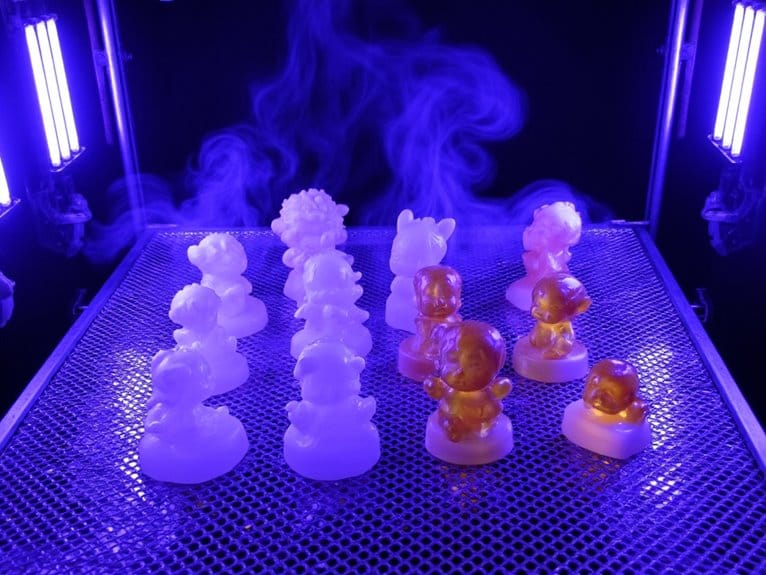
Post-processing tools include sandpaper sets for smoothing surfaces and tweezers for handling delicate parts. Deburring tools enhance surface quality by removing unwanted material from printed edges and surfaces. UV curing stations enhance resin print durability. Filament dryers provide essential heated environments to prevent moisture-related print failures.
Tool storage solutions prevent loss of accessories and allow easy access to frequently used maintenance equipment.
These accessories transform printing from frustrating experimentation into reliable manufacturing.
Advanced Upgrades for Enhanced Performance
You’ll find that dual extrusion systems and smart control features represent the pinnacle of 3D printer upgrades for the enthusiast in your life.
These advanced modifications transform a basic printer into a professional-grade manufacturing tool capable of multi-material printing and remote operation.
The technical complexity of these upgrades means they’re perfect for someone who’s already mastered their printer’s basics and wants to push creative boundaries.
Dual Extrusion Systems
| Feature | Single Extruder | Dual Extruder |
|---|---|---|
| Material Types | One per print | Two simultaneous |
| Support Removal | Manual scraping | Soluble dissolution |
| Color Options | Single/manual changes | Automated multi-color |
| Print Complexity | Limited overhangs | Complex geometries |
| Setup Difficulty | Basic calibration | Precise nozzle alignment |
However, expect increased calibration complexity and higher maintenance requirements compared to standard systems.
Smart Control Features
Modern 3D printers can transform from basic fabrication tools into sophisticated manufacturing systems through smart control upgrades that automate complex processes and enhance precision.
Cloud-based platforms like ZAP integrate multiple machines regardless of manufacturer, creating unified automated workflows that eliminate manual intervention. You’ll reduce hidden costs related to equipment management and personnel oversight through centralized control interfaces.
Advanced motion control systems enable simultaneous operation of multiple printers with EtherCat connectivity for high-precision coordination.
T-Code eliminates G-Code pauses, allowing continuous printing with multifunctional printheads that mix materials without interruption.
Real-time flow monitoring adjusts extrusion rates automatically, compensating for filament inconsistencies.
Smart control features include active temperature management maintaining stable chamber conditions and dynamic workflow automation from design to production, considerably improving print quality while reducing defects.
Digital Software and Online Resources
Several powerful software options can dramatically expand a 3D printer owner’s creative capabilities and streamline their workflow.
Software licenses for professional tools like SolidWorks provide NURBS-based modeling with precise engineering capabilities, while Simplify3D offers advanced slicing algorithms and customizable support structures.
Free alternatives include Ultimaker Cura for reliable print preparation and Blender’s open-source modeling suite.
Cloud-based platforms like TinkerCAD and Onshape enable collaborative design workflows without installation requirements.
For artistic applications, Maya delivers mathematically smooth surfaces ideal for sculptural forms.
Online courses complement these tools by teaching advanced techniques and workflow optimization.
Autodesk Fusion 360 integrates CAD, simulation, and slicing in one extensive package, making it valuable for professional makers requiring complete design-to-print solutions.
Creative Specialty Filaments and Materials
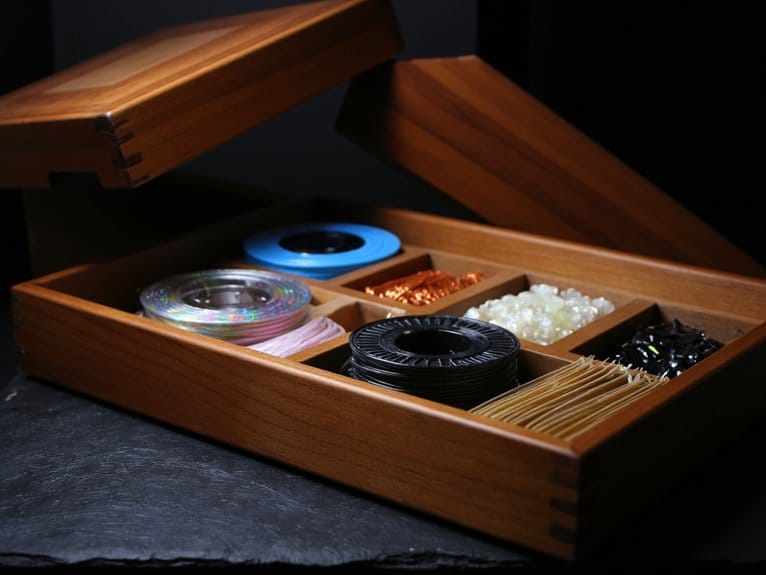
You can transform someone’s 3D printing experience by gifting specialty filaments that go far beyond standard PLA and ABS materials.
Glow-in-the-dark filaments incorporate phosphorescent particles that charge under light and emit a luminous green or blue glow for hours, while flexible TPU materials with shore A hardness around 93 let them create bendable phone cases and wearable accessories.
Wood-infused filaments blend PLA polymer with real wood particles, producing prints that smell like fresh timber and can be sanded, stained, or finished just like traditional woodwork.
Glow-in-the-Dark Options
When someone with a 3D printer wants to create objects that literally light up the night, glow-in-the-dark filaments offer an exceptional blend of functionality and visual appeal. These PLA or ABS polymers contain phosphorescent particles that store light energy and release it in darkness. Green variants provide the strongest glow intensity and longest duration, while blue offers decent alternatives for varied glow in the dark colors.
| Brand | Base Material | Notable Feature |
|---|---|---|
| eSUN PLA Luminous | PLA | Strong green glow effect |
| ColorFabb GlowFill | PLA | Ivory matte finish, bright glow |
You’ll need hardened steel nozzles due to abrasive particles. Print at 210°C with 50°C bed temperatures. Glow in the dark applications include safety markers, decorative items, and educational demonstrations showcasing phosphorescence principles. For users seeking more robust alternative materials, nylon filaments can provide exceptional durability with 10x the toughness of standard PLA while maintaining compatibility with various 3D printer setups.
Flexible Printing Materials
While glow-in-the-dark filaments create striking visual effects, flexible printing materials open up an entirely different domain of functional possibilities for 3D printing enthusiasts.
You’ll find flexible filament options ranging from semi-flexible TPU with Shore A hardness around 90 to ultra-flexible variants at 60 hardness. TPU remains the most accessible choice, offering strong shock resistance and moderate rigidity that simplifies printing.
These materials present distinct printing challenges. You’ll need direct-drive extruders for softer variants, slower print speeds, and careful retraction settings. TPC requires temperatures exceeding 230°C and ambient temperature loading.
Ultra-flexible TPU demands specialized equipment like Flexion Extruders. Applications include functional gaskets, phone cases, automotive bumpers, and wearable hinges.
For superior quality, consider SLS flexible TPU powders, though they’re costlier than standard filaments.
Wood-Infused Filament Types
Wood-infused filaments transform ordinary 3D printing into an authentic woodworking experience, combining PLA polymer bases with genuine wood particles to create prints that look, feel, and even smell like real wood.
You’ll find wood filament types containing 20-40% wood derivatives like sawdust, cork, or pinewood fibers mixed with PLA. Premium variants like colorFabb woodFill use fine pinewood fibers for enhanced texture.
The printing characteristics require temperatures between 195-220°C with standard 0.4mm nozzles, though larger sizes prevent particle clogs.
Your finished prints develop wood-like grain patterns and matte surfaces that accept sanding, staining, and painting. While less flexible than pure PLA, these filaments offer strong interlayer adhesion and biodegradability.
They’re perfect for decorative models, architectural prototypes, and educational projects where authentic wood aesthetics matter more than mechanical strength.
Maintenance and Replacement Components
Regular maintenance forms the backbone of 3D printer reliability, and having the right replacement components on hand prevents costly downtime when parts inevitably fail.
Maintenance kits make excellent gifts because they contain essential consumables like nozzles, thermistors, and heating cartridges. These components wear out predictably and require replacement every few months.
Replacement tools complement these kits perfectly. Nozzle cleaning needles, brass brushes, and brass wire brushes remove stubborn clogs without damaging delicate surfaces.
Quality cooling fans prevent overheating during extended print sessions. Belts and pulleys maintain mechanical precision as original parts stretch or wear.
Consider gifting silicone-based lubricants for smooth rail operation and isopropyl alcohol for bed preparation. These consumables support monthly cleaning routines that extend printer lifespan greatly.
Workspace Organization Solutions
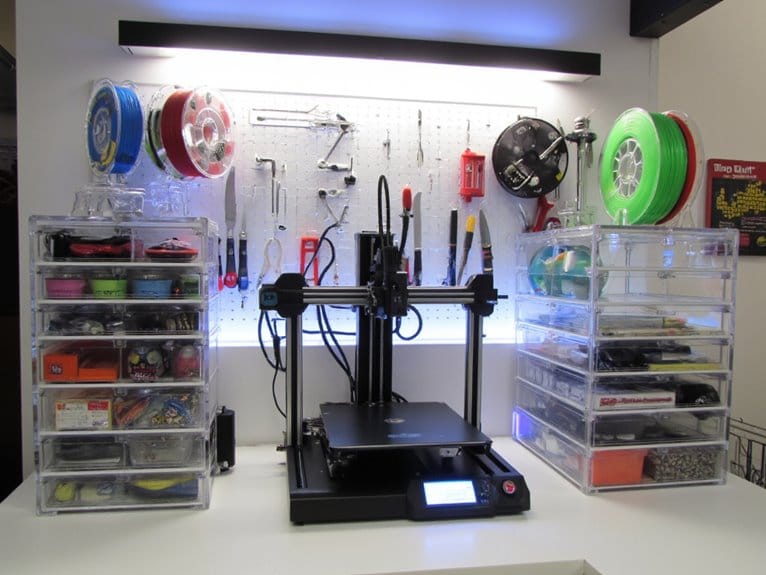
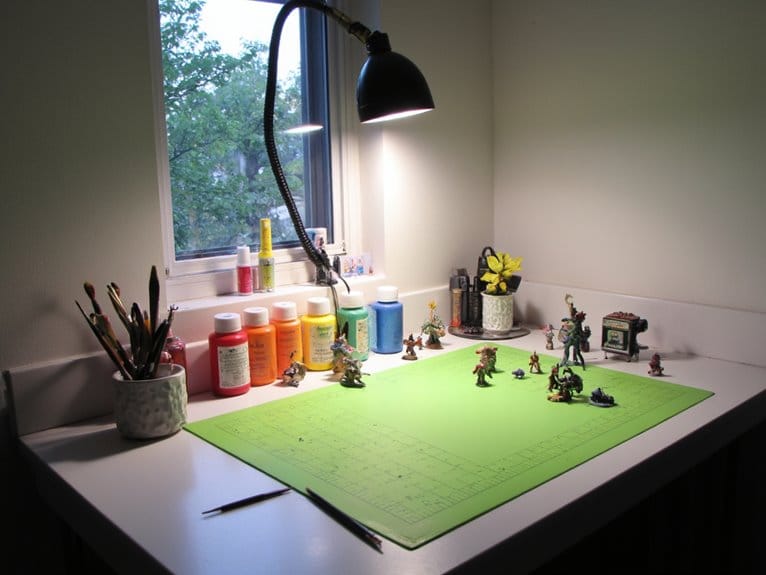
Clutter becomes the enemy of efficient 3D printing workflows, transforming productive workspaces into frustrating obstacle courses of misplaced tools and scattered components.
Disorganized 3D printing spaces sabotage productivity, turning creative workflows into time-wasting hunts for essential tools and materials.
Wall mounted systems like Honeycomb Storage and Multiboard maximize vertical space through modular pegboard designs. You’ll need approximately 70 hours to print a complete 7×4 hexagonal panel wall, but the customizable tiles accommodate various accessories perfectly.
Drawer organizers eliminate small item chaos by creating custom-fitted compartments for cables, electronics, and consumables.
Grid based solutions like Gridfinity standardize storage using 50mm cube modules that stack and interconnect seamlessly.
Consider these organization gifts:
- Honeycomb Storage Wall panels – hexagonal modular tiles
- Gridfinity starter sets – standardized grid containers
- Custom layout models – scaled workspace planning tools at 25.4:1 ratio
These systems transform chaotic workshops into precisely organized manufacturing environments.
Gift Cards and Store Credits
Three gift card formats dominate the 3D printing market: digital delivery, physical cards, and downloadable STL files for self-printing. Digital cards arrive via email with online redemption instructions, offering instant delivery for last-minute gifts. Physical cards ship directly or can be purchased in-store.
Gift card benefits include flexibility when you’re unsure about specific filament preferences or printer compatibility. Recipients choose from extensive catalogs covering filaments, resins, replacement parts, and complete printer systems.
Popular vendors like MatterHackers offer denominations from $25 to $1,000, while Ultimate 3D Printing Store cards remain valid for five years.
Most gift cards can’t be returned or refunded. International orders may incur additional duties and taxes.
Coex 3D provides unique STL files for printing physical gift cards at home.
On a final note
You’ll find the perfect gift by matching your recipient’s specific 3D printing needs. Beginners benefit most from quality PLA filament and basic tools. Experienced users appreciate advanced upgrades like all-metal hotends or precision nozzles. Professional operators value specialty materials and workspace organization. Don’t overlook maintenance supplies-they’re always needed. When you’re unsure about compatibility or preferences, store gift cards provide flexibility. Focus on practical items that’ll enhance their printing capabilities and workflow efficiency.