We are supported by our audience. When you purchase through links on our site, we may earn an affiliate commission, at no extra cost for you. Learn more. Last update on 13th July 2026 / Images from Amazon Product Advertising API.
Not every 3D printer can produce quality miniatures. You’ll need specific capabilities for success: SLA or DLP printers achieve 25-50 micron XY resolution with 0.05-0.1mm layer heights, while budget FDM printers typically max out at 0.1-0.2mm layers, limiting detail reproduction. Resin printers deliver superior results with smooth surfaces and exceptional detail retention under 20 microns precision. Entry-level printers often lack the mechanical precision required for intricate miniature features. Understanding these technical requirements and post-processing techniques will determine your miniature printing outcomes.
Notable Insights
- Not all 3D printers can effectively print miniatures due to resolution limitations and technical constraints.
- FDM printers with 0.4mm nozzles struggle with fine details compared to resin-based SLA/DLP printers.
- Resin printers achieve superior detail with 25-50 micron resolution, ideal for miniature specifications.
- Budget FDM printers limited to 0.1-0.2mm layer heights cannot reproduce intricate miniature features.
- High-quality miniatures require printers capable of sub-100 micron features and precise support structures.
Understanding 3D Printer Types for Miniature Production
The landscape of 3D printing technologies offers distinct advantages for miniature production, with each method delivering different levels of detail, speed, and cost-effectiveness.
Understanding printer compatibility with your specific miniature requirements determines success.
Fused Deposition Modeling (FDM) printers use melted filament through nozzles. They’re affordable and accessible but produce less fine detail than resin alternatives. You’ll find them suitable for terrain and larger models.
Stereolithography (SLA) and Digital Light Processing (DLP) printers cure photopolymer resin with UV light. These deliver exceptional precision with layer heights as fine as 25 microns.
LCD-based resin printers offer similar accuracy at lower costs. Professional-grade printers achieve minimum layer resolution as low as 0.01mm precision. DLP technology uses UV projectors for faster printing compared to SLA systems.
Technology evolution has made resin printers the preferred choice for detailed miniatures. They consistently achieve smooth surfaces and intricate features that FDM technology can’t match at miniature scales. Modern high-resolution printers with 16K LCD screens can achieve layer details down to 14 x 19 microns for exceptional miniature quality. For optimal miniature quality, recommended layer heights should range between 0.05mm and 0.1mm regardless of printer type. The build volume requirements affect your project scale, with many miniature printers offering adequate space for batch printing multiple figures simultaneously. Features like automated leveling are critical for ensuring consistent print quality, especially when printing multiple miniatures in a single batch.
Material Selection Impact on Miniature Quality
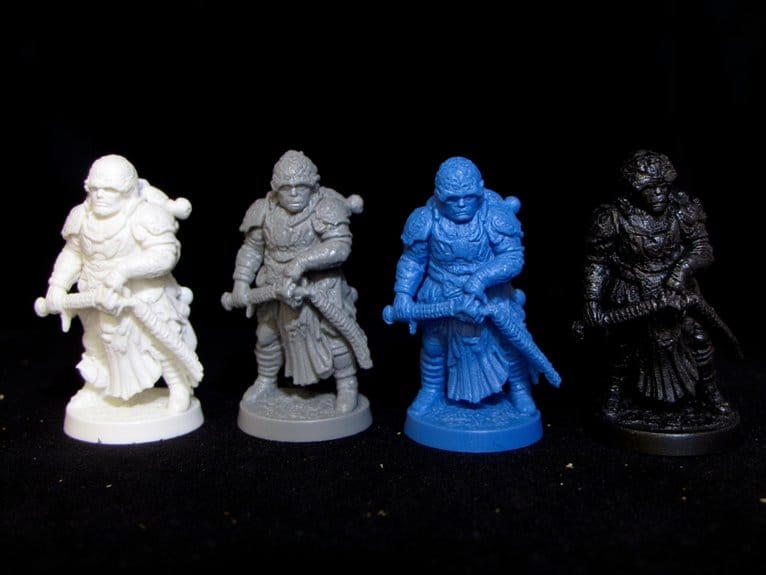
Your material choice fundamentally determines whether you’ll achieve professional-grade miniatures or settle for acceptable hobby-level results.
Resin materials deliver exceptional detail resolution with layer thicknesses as fine as 25 microns, while filament-based materials like PLA typically produce thicker layer lines requiring extensive post-processing. The smooth surfaces produced by resin significantly reduce post-processing time compared to traditional filament printing methods.
PLA filaments offer reliable layer adhesion and are ideal for beginners, though they require careful temperature control between 170-230°C to achieve optimal miniature detail.
High-resolution resin printers achieve below 20 microns layer precision, which results in smooth surface finishes ideal for detailed figurine work. Advanced resin formulations designed for miniatures feature fast curing times that enhance design integrity while maintaining exceptional detail resolution.
The surface finish differences between these materials directly impact paint adhesion quality, assembly precision, and the overall aesthetic appeal of your finished miniatures. Professional painters often choose resin-printed miniatures because they provide excellent adherence to acrylic paints and require minimal surface preparation before painting.
Resin Vs Filament Properties
When choosing between resin and filament for miniature printing, material properties directly determine your final print quality, durability, and overall project success.
Resin brittleness remains its primary weakness, making printed miniatures prone to breaking under stress or rough handling. However, resin delivers exceptional detail fidelity with 25-50 micron layer heights that capture intricate textures impossible with standard filament printing.
Filament strength provides superior durability for gaming miniatures that’ll experience frequent handling. Materials like ABS and PETG maintain structural integrity even at thin wall thicknesses.
The trade-off comes in resolution limitations-typical 0.4mm nozzles can’t match resin’s fine detail capture.
Your choice depends on intended use: choose resin for display-quality collectibles requiring maximum detail, or select filament for robust gaming pieces prioritizing durability over precision. For filament printing, dimensional accuracy of ±0.02mm proves crucial for miniatures with intricate designs and precise assemblage requirements. Once printed, proper painting preparation enhances the final appearance, with light contrast undercoats being essential for achieving desired depth and visual effects on miniature surfaces. Chemical compatibility between your chosen paint and filament material ensures proper adhesion and prevents peeling or chipping during handling. Quality texture sand provides realistic basing effects that complement your printed miniatures with authentic surface details.
Surface Finish Differences
Beyond material choice alone, surface finish quality separates amateur-looking miniatures from professional results, with resin and filament requiring dramatically different post-processing approaches.
Resin prints achieve 25-micron resolution with naturally smooth surfaces, minimizing finishing requirements.
FDM prints display visible layer lines that demand extensive post-processing. Your finishing method selection depends on four critical factors:
- Material compatibility – Vapor polishing works with specific plastics but risks warping thin features
- Detail preservation – Sanding techniques offer control but struggle with undercuts and recessed areas
- Surface accessibility – Bead blasting reaches complex internal channels while maintaining dimensional accuracy
- Durability requirements – Aggressive finishing can compromise tensile strength and dimensional precision
Chemical vapor polishing creates glossy surfaces ideal for display pieces.
Media tumbling improves uniformity but may round sharp edges on delicate miniatures.
ABS filaments require heated beds between 220-260°C and proper ventilation to achieve optimal results for miniature printing applications.
Proper surface preparation ensures optimal primer adhesion and significantly improves the final painted finish quality of your miniatures.
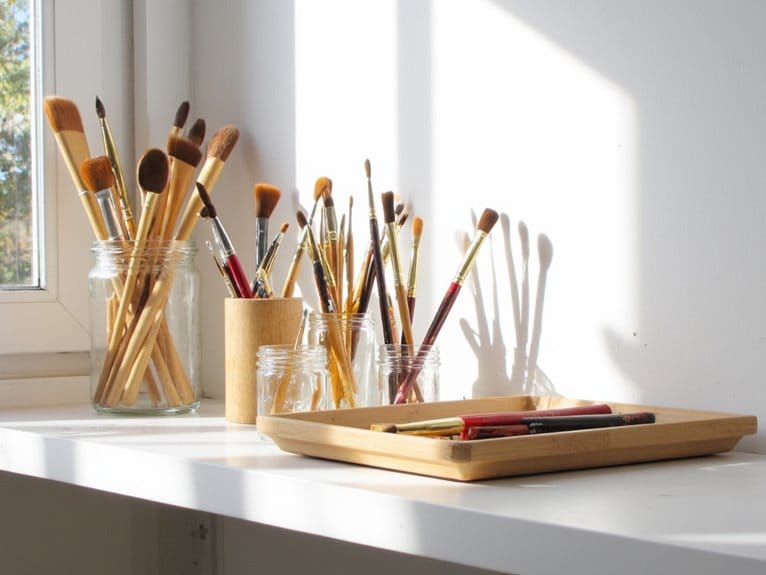
Professional painted finish quality depends heavily on using high-quality brushes and specialized painting accessories designed specifically for miniature work.
High-quality filaments enhance the final print quality and detail, providing superior base material for achieving professional-grade surface finishes on miniatures.
Support Structure Design and Optimization
Although 3D printing technology has advanced considerably, support structures remain the critical bridge between digital design and physical reality when creating miniatures. You’ll need strategic design strategies that balance stability with surface preservation. Manual support placement outperforms automatic generation for intricate details, allowing precise control over contact points.
| Support Type | Contact Area | Removal Difficulty |
|---|---|---|
| Light Dense | 0.2-0.4mm | Easy |
| Medium Dense | 0.4-0.8mm | Moderate |
| Heavy Dense | 0.8-1.2mm | Difficult |
| Manual Points | 0.1-0.3mm | Variable |
| Auto Generated | 0.5-1.0mm | Hard |
Smart orientation reduces suction forces during printing. You should increase support density rather than thickness when scaling models. Optimization techniques include adjusting loop count to match your nozzle diameter and positioning supports on hidden surfaces. Maintaining ±0.1mm accuracy throughout the printing process ensures support structures form correctly and detach cleanly from miniature details. Just as artists must clean their brushes immediately with warm soapy water to maintain performance, immediate cleaning of support contact points during removal prevents surface damage. Effective support removal requires specialized tools and careful parameter tuning. After removing supports, precision tweezers and specialized scrapers help achieve professional finishing quality on miniature surfaces. Filaments with superior dimensional accuracy like SUNLU PLA at ±0.02mm tolerance help ensure support structures form precisely and detach cleanly from miniature surfaces.
Detail Resolution and Surface Finish Capabilities
Once your support structures are refined, the printer’s resolution capabilities determine whether fine details like chainmail links, facial expressions, and weapon engravings will emerge clearly from your miniature prints.
Resolution trade offs directly impact your final results. SLA and DLP printers achieve 25-50 micron XY resolution, while FDM printers typically max out at 400 microns due to nozzle diameter limitations.
For ideal miniature quality, target these specifications:
- XY Resolution: 35 microns or lower for clear detail capture
- Layer Height: 0.05-0.1mm for smooth surface finish
- Minimum Feature Size: Under 100 microns for intricate textures
- Print Speed Considerations: Higher resolution increases processing time considerably
Resin printers deliver superior surface finish through precise UV curing. High-quality resins achieve minimal shrinkage rates that preserve dimensional accuracy and fine detail reproduction essential for miniature work. Digital calipers enable accurate measurement and quality control to verify that your printed miniatures maintain the precise dimensions required for tabletop gaming.
Layer heights below 0.05mm provide smooth surfaces but extend print duration greatly. Once printing is complete, applying a protective varnish coating becomes essential to maintain the intricate details and prevent damage during handling.
Professional-grade printers with all-metal nozzles can handle the high-temperature requirements needed for specialty materials that may enhance miniature durability and detail retention.
Scaling Production for Cost-Effective Manufacturing
When you’re ready to move from single prints to larger production runs, understanding cost dynamics becomes essential for sustainable miniature manufacturing. Your batch efficiency improves remarkably as setup costs spread across more units. Resin material costs drop from €0.20 per miniature to considerably less with bulk purchasing.
Production scalability depends on maximizing your printer’s build volume. Resin printers maintain consistent print times regardless of quantity, while FDM printers increase proportionally with each model. Post-processing equipment like ultrasonic cleaners can significantly improve workflow efficiency when handling multiple printed miniatures simultaneously.
| Factor | Small Batch | Large Batch |
|---|---|---|
| Material Cost | €0.20/unit | €0.12/unit |
| Setup Time | High per unit | Low per unit |
| Quality Control | Manual | Systematic required |
| Labor Requirements | Minimal | Skilled operators |
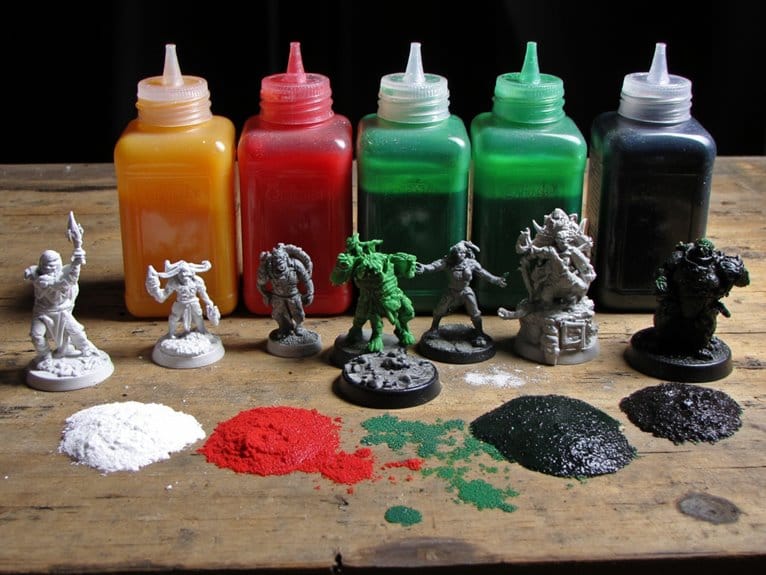
Digital workflows streamline your progression from design to print. You’ll need robust quality control systems and proper ventilation for scaled resin operations. Professional finishing requires precision control through quality airbrushes, which enhance miniature details with fine paint application and consistent spray patterns. High-quality pre-thinned colors eliminate the need for manual mixing, ensuring consistent results across large production batches while preventing clogging issues that can slow manufacturing workflows. Efficient cleaning pots with proper filtration systems ensure mess-free paint maintenance during extended production sessions.
Technical Limitations of Entry-Level Printers
While scaling up production offers compelling economic advantages, entry-level 3D printers present considerable technical barriers that can derail your miniature manufacturing plans. Budget FDM printers typically achieve minimum layer heights of 0.1-0.2mm, which creates limited detail reproduction on small-scale models.
Budget FDM printers’ 0.1-0.2mm layer heights create significant technical barriers that can derail professional miniature manufacturing plans.
Mechanical imprecision from low-quality stepper motors and frame instability causes layer misalignment and dimensional inaccuracies.
Key technical constraints include:
- Nozzle diameter limitations – Standard 0.4mm nozzles can’t reproduce features smaller than their extrusion width
- Support structure challenges – Non-soluble supports damage delicate miniature components during removal
- Material restrictions – PLA and ABS filaments lack the resolution capabilities of specialized resins
- Software limitations – Basic slicing profiles don’t optimize settings for miniature-scale printing requirements
These hardware and software restrictions considerably impact your ability to achieve professional miniature quality. However, some high-performance models can achieve precision printing with 0.05mm accuracy, significantly improving detail reproduction capabilities for miniature projects.
Post-Processing Requirements for Professional Results
Even the most precisely printed miniature requires extensive post-processing to achieve professional-quality results that rival traditionally manufactured gaming pieces. You’ll need to master multiple post processing techniques to transform raw prints into display-worthy models.
| Process Stage | Time Required | Skill Level |
|---|---|---|
| Support Removal | 15-30 minutes | Beginner |
| Surface Sanding | 1-2 hours | Intermediate |
| Gap Filling | 30-45 minutes | Advanced |
| Priming/Painting | 2-4 hours | Expert |
Support removal comes first-snap off structures carefully to preserve delicate details. Sand progressively from 400 to 800 grit to eliminate layer lines. Fill imperfections with epoxy resin or ABS compounds. Prime surfaces before applying base colors. After priming, apply miniature washes to enhance depth and create realistic shading effects that bring your printed models to life. These finishing touches separate amateur prints from professional miniatures, requiring patience and precision for superior results.
On a final note
You’ll achieve quality miniatures only when you match your printer’s capabilities to your project requirements. Entry-level FDM printers can’t deliver the 0.1mm detail resolution that quality miniatures demand. Resin printers provide superior results but require extensive post-processing. Consider your budget, production volume, and detail expectations before investing. Professional-grade results aren’t guaranteed-they’re earned through proper equipment selection, material choice, and meticulous technique refinement.