We are supported by our audience. When you purchase through links on our site, we may earn an affiliate commission, at no extra cost for you. Learn more. Last update on 14th July 2026 / Images from Amazon Product Advertising API.
Nuln Oil is a black acrylic wash paint designed for miniature models that automatically flows into recesses and details to create realistic shadows and depth. You’ll find it’s water-based with low surface tension, allowing it to settle naturally into panel lines, armor joints, and textured surfaces without obscuring fine details. The formula produces deep black pigmentation with a matte finish that enhances both warm and cool tones underneath. This technique requires minimal brushwork and works best on primed surfaces at temperatures between 55-75°F for ideal flow characteristics and professional results across your miniature projects.
Notable Insights
- Nuln Oil is an acrylic-based shade wash paint used in miniature painting to create depth and natural shadows.
- It flows into recesses and crevices using capillary action, enhancing detail without obscuring fine features on models.
- The water-based formula contains finely ground black pigments that dry to a matte finish for realistic effects.
- It excels at defining metallic details, armored surfaces, chainmail textures, and mechanical components on miniatures.
- Nuln Oil is beginner-friendly, requiring minimal brushwork while delivering professional-looking results across various paint systems.
Understanding Shade Washes and Their Purpose
Shade washes represent one of the most fundamental techniques in miniature painting, functioning as thin, translucent layers that automatically create depth and definition on your models.
These fluid paint applications flow naturally into crevices and recesses, depositing darker pigments where shadows would naturally occur. The semi-transparent consistency allows raised surfaces to remain lighter while detailed areas receive enhanced contrast.
You’ll achieve professional-looking results with minimal brushwork. Shade washes typically dry within 15 minutes, though application thickness affects timing.
They’re particularly effective for beginners since they require no advanced skills yet dramatically improve visual complexity. The technique unifies color schemes by creating cohesive shading across entire models.
Unlike standard paints that provide uniform coverage, shade washes enhance existing detail rather than obscuring it, making them essential for realistic miniature finishing. These washes are 100% mixable, allowing you to create custom colors for specific effects.
You can create your own washes by mixing acrylic medium with regular paint using a 50/50 ratio for general application. Higher-priced washes typically provide superior coverage, requiring fewer applications and leading to long-term value for modelers.
Advanced techniques like wet blending can be combined with shade washes to create smooth transitions and professional-grade weathering effects on miniature surfaces. For optimal results, apply shade washes over light primers such as white or light gray, which enhance the natural flow and contrast effects.
Water-based shade washes offer non-toxic formulas that provide safer working conditions while maintaining easy cleanup and professional results.
Key Properties and Characteristics of Nuln Oil
When examining Nuln Oil’s fundamental characteristics, you’ll discover it’s an acrylic-based wash formulated with finely ground black pigments suspended in a specialized medium.
The water-based formula features low surface tension, allowing ideal wash viscosity that flows naturally into model recesses. This shade consistency guarantees even coverage across detailed surfaces without pooling or streaking.
The low surface tension formula ensures optimal flow into recesses while maintaining consistent coverage without unwanted pooling or streak formation.
Key visual properties include:
- Deep black pigmentation that creates natural-looking shadows and depth
- Matte finish texture that eliminates unwanted shine on miniature surfaces
- Thin liquid consistency that penetrates intricate sculpted details effectively
- Smooth drying characteristics that preserve fine model features without clogging
The formula dries quickly to a durable finish. This essential paint serves as an ideal foundation color for miniature painting beginners developing their technique.
You can warm the container to improve flow properties and reduce matting agent visibility. Multiple thin layers build gradually without obscuring detail work. The water-based acrylic formulation provides easy cleanup and non-toxic handling compared to other paint types.
Best Applications and Compatible Surfaces
You’ll find Nuln Oil performs best on specific surface types and applications where its dark shading properties enhance rather than muddy your miniature’s appearance.
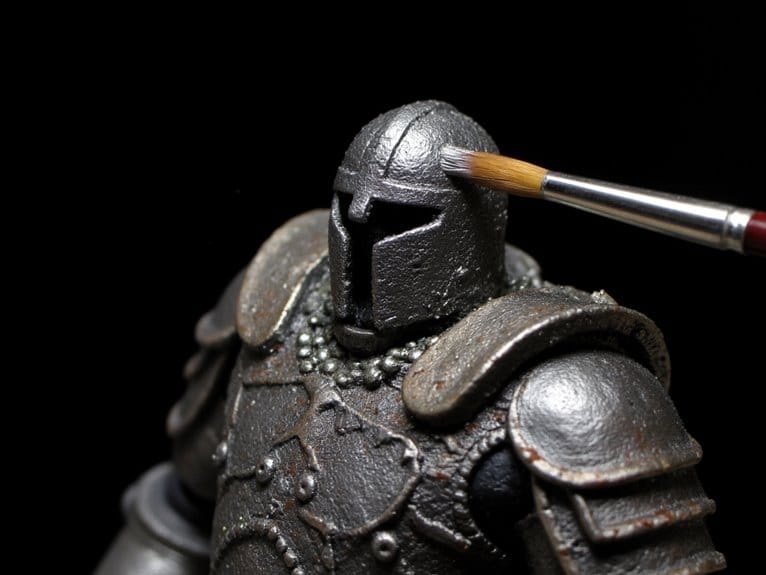
The wash excels at bringing out metallic details, defining panel lines and mechanical components, and adding realistic depth to armored surfaces.
Understanding which colors and materials work well with this black wash-and which don’t-will help you achieve professional-quality results on your models.
Metallic Surface Enhancement
Metallic surfaces present unique challenges for miniature painters seeking to enhance depth and realism without sacrificing the inherent shine that makes metals visually striking. Nuln Oil excels at creating sophisticated metallic textures through controlled shading applications.
You’ll achieve ideal results by applying thin coats that flow naturally into recesses while preserving surface detail.
The shade enhances various metallic applications through these surface refinements:
- Armor plating – Creates realistic shadowed gaps between overlapping metal segments
- Chainmail textures – Accentuates individual links for improved visual separation
- Mechanical components – Adds weathering effects simulating operational wear patterns
- Weapons and tools – Develops authentic aging through controlled contrast enhancement
Use gloss variants to maintain metallic luster while achieving shading effects. Proper surface preparation guarantees even coverage without distortion. Acrylic paints are recommended for plastic miniatures, while metallic surfaces may need better bonding formulations to ensure proper adhesion. Glossy finishes enhance vibrancy and depth while providing ideal enhancement for metallic surfaces. After completing your metallic shading work, apply protective varnishes specifically designed for metal surfaces to prevent peeling and maintain the enhanced details against wear and handling.
Panel Line Definition
Although Nuln Oil functions as a general-purpose shade, it transforms into a precision tool when applied for panel line definition on scale models and detailed miniatures. You’ll achieve superior results on Gundam Gunpla, military vehicles, and sci-fi miniatures where structural separations require enhancement.
| Surface Type | Compatibility | Wash Behavior | Cleanup Method | Result Quality |
|---|---|---|---|---|
| Primed Plastic | Excellent | Flows smoothly | Thinner/cotton swab | Clean definition |
| Acrylic Paint | Very Good | Controlled flow | Mineral spirits | Minimal staining |
| Lacquer Finish | Good | Predictable | Enamel thinner | Sharp lines |
| Unpainted Plastic | Fair | May bead | Gentle solvents | Variable |
| White/Light Colors | Requires care | Potential staining | Immediate cleanup | Needs touch-ups |
Panel line techniques using Nuln Oil rely on capillary action for automatic pigment flow. Panel line materials should include fine brushes and appropriate thinners for ideal definition.
Color Compatibility Guide
Understanding Nuln Oil‘s color properties enables precise application across diverse miniature painting scenarios.
You’ll find excellent acrylic compatibility with most miniature paint systems, making shifts between brands seamless. The hex code #14100e matches closely with established color standards, ensuring consistent results across projects.
When selecting wash alternatives, consider these compatibility factors:
- Base coat adhesion – Works best over properly primed surfaces with matte finishes
- Color interaction – Enhances warm and cool tones without shifting underlying hues notably
- Layer building – Compatible with subsequent highlighting using opaque acrylics
- Surface tension – Flows naturally into recesses on textured miniature details
Multiple thin applications provide superior control compared to single heavy coats. For optimal results, maintain application temperatures between 55-75°F to ensure proper flow and adhesion characteristics.
You can confidently layer Nuln Oil over Citadel, Vallejo, or Army Painter base colors without adverse reactions. Like other acrylic-based primers, Nuln Oil works effectively on plastic and metal materials for superior adhesion. Applying washes with precision detail brushes ensures optimal flow control and prevents unwanted pooling on flat surfaces.
Sets with high-pigment formulas deliver more intense color depth, requiring fewer wash applications to achieve desired shading effects.
Essential Techniques for Proper Application
When you’re ready to apply Nuln Oil to your miniatures, proper preparation sets the foundation for professional results. Clean, dry surfaces guarantee ideal adhesion and flow characteristics. Your brush techniques directly impact final quality-use fine detail brushes for precision control in recesses and crevices.
Wash consistency determines shading intensity. Undiluted Nuln Oil creates deep shadows, while slight water dilution produces subtler effects. Apply liberally to recesses but avoid excessive spillover onto flat surfaces. Use gravity by angling your miniature to guide flow naturally.
| Application Stage | Key Technique | Critical Point |
|---|---|---|
| Preparation | Surface cleaning | Completely dry before application |
| Application | Recess targeting | Focus on shadows and crevices |
| Cleanup | Immediate wiping | Remove excess before drying |
Multiple thin layers build gradual shading without overwhelming paint texture. Ergonomic handles reduce hand fatigue during extended painting sessions, especially when applying washes across multiple miniatures. For securing basing materials after your wash has cured, precision applicator tips provide controlled placement without disturbing your carefully applied shading work. A stay wet palette keeps your wash mixture workable for extended periods during long painting sessions. Working in well-ventilated areas prevents the buildup of potentially harmful fumes from adhesives and solvents used in the modeling process.
Benefits for Miniature Painting Projects
Nuln Oil delivers immediate contrast enhancement that transforms flat-painted miniatures into visually striking models with minimal effort. The Nuln Oil advantages include versatile application across multiple surface types and rapid shading coverage for large projects.
Transform flat miniatures into visually striking models with minimal effort through immediate contrast enhancement and versatile application capabilities.
Model shading techniques benefit greatly from its pooling behavior in recesses and crevices.
Key benefits include:
- Metallic Enhancement – Creates realistic pressed metal effects on silver surfaces while emphasizing fine details
- Batch Processing – Enables uniform shading across multiple miniatures simultaneously for stylistic consistency
- Depth Creation – Darkens shadows effectively regardless of ambient lighting conditions, making models visually pop
- Time Efficiency – Reduces extensive blending requirements by providing immediate tonal variation without intricate brushwork
Ready-to-use formulation eliminates mixing preparation, though precise application control prevents over-coverage requiring touch-ups. The matte black finish provides professional-grade detail enhancement that flows naturally into recesses without creating unwanted shine or gloss effects. For painters seeking consistent application capabilities across detailed work, the ready-to-spray formula approach ensures reliable coverage without the need for complex preparation steps. Professional modelers often complement their wash techniques with water-based acrylic formulations that provide similar quick-drying properties and excellent surface adhesion. Using a wet palette between sessions can keep any remaining Nuln Oil workable for extended periods while reducing waste.
Common Challenges and How to Avoid Them
While Nuln Oil offers excellent shading capabilities, you’ll encounter several common application challenges that can compromise your results if not properly addressed.
The most frequent issues include wash pooling in flat areas, color compatibility problems with certain base paints, and technique mistakes during application that create uneven coverage.
Understanding these pitfalls and implementing proper prevention strategies will help you achieve consistent, professional-looking results every time you use this popular wash.
If you make significant mistakes during application, specialized paint removers designed for miniatures can safely strip the wash without damaging fine details on your models.
Preventing Pooling Issues
One of the most frustrating problems you’ll encounter with Nuln Oil is unwanted pooling on flat surfaces, which creates uneven coverage and unsightly tide marks.
The solution involves proper surface preparation using gloss varnish, which dramatically improves wash flow control.
Apply a thin gloss varnish coat before washing. This creates ideal surface tension that directs the wash into recesses while preventing flat surface accumulation.
Follow these essential steps:
- Spray gloss varnish evenly across the model surface
- Allow complete drying before wash application
- Apply Nuln Oil in small, controlled sections
- Wick away excess pooling with a clean brush immediately
Multiple thin varnish layers work better than single thick applications.
Avoid matte finishes, which don’t provide adequate pooling prevention due to inferior surface tension properties.
Color Compatibility Problems
Color compatibility represents the most technically complex challenge when working with Nuln Oil, as this wash interacts differently with various paint formulations and surface preparations.
You’ll encounter color shifts when applying Nuln Oil over certain base paints, particularly lighter colors that can appear muddy or lose vibrancy. Non-acrylic paints create unpredictable absorption rates and drying inconsistencies that affect final appearance.
Different paint brands react variably with Nuln Oil’s formulation. You may notice dulled highlights or altered base tones when the wash interacts with incompatible paint chemistry.
Non-validated paint combinations often produce uneven coverage and unexpected color changes.
Always test compatibility on spare models first. Apply small patches to verify color interaction before committing to your primary miniature. This prevents costly mistakes and guarantees predictable results across your painting projects.
Application Technique Mistakes
Proper application technique determines the difference between professional-looking miniatures and disappointing results that require extensive rework.
Most application errors stem from poor wash control and insufficient understanding of timing requirements.
Common technique mistakes include:
- Oversaturated brush loading – Creates uncontrollable drips and runs on vertical surfaces
- Excessive layer thickness – Produces unwanted glossy finish and obscures fine details
- Inadequate excess removal – Results in pooling, halos, and dark patches in wrong locations
- Improper timing sequences – Rushing between coats creates muddied colors and spotty coverage
Multiple thin applications with proper drying intervals provide superior results compared to single heavy coats.
Use appropriately sized brushes for controlled placement.
Remove surplus wash promptly before hardening occurs.
Environmental factors affect drying times, requiring technique adjustments for ideal finish quality.
Comparing Nuln Oil to Other Shade Products
When evaluating Nuln Oil against other shade products in the Citadel range, you’ll notice distinct formula differences that affect performance and application.
Agrax Earthshade delivers brown, earth-toned effects compared to Nuln Oil’s cooler black shading. Sepia provides lighter, warm filtering between these two extremes. Each serves specific purposes: Nuln Oil excels on greys and blacks, Agrax Earthshade suits warm browns, while Sepia handles mid-tone applications effectively.
For deeper black effects, thinned Black Templar Contrast paint offers viable Nuln Oil alternatives, though it requires careful handling.
The new Nuln Oil formula reduces staining and improves recess flow compared to traditional washes. When shade layering, consider surface color compatibility. Nuln Oil works across broader base color ranges than before, while Agrax remains ideal for metallic surfaces requiring pronounced shadows.
On a final note
You’ve now got the essential knowledge to use Nuln Oil effectively in your miniature painting projects. This versatile shade wash will enhance your models’ depth and realism when you apply proper thinning ratios and coverage techniques. Remember to work in thin layers and control pooling for best results. You’ll find it’s an indispensable tool that’ll elevate your painting quality with consistent practice and attention to application fundamentals.