We are supported by our audience. When you purchase through links on our site, we may earn an affiliate commission, at no extra cost for you. Learn more. Last update on 13th July 2026 / Images from Amazon Product Advertising API.
Essential 3D printer accessories include airtight filament storage containers with silica gel desiccants to prevent moisture absorption, hardened steel nozzles for printing abrasive materials like carbon fiber, and bed adhesion solutions such as PEI sheets or specialized adhesives like Magigoo. You’ll also need digital calipers for precision measurement, craft knives and tweezers for post-processing, and heated enclosures for temperature-sensitive materials. These foundational upgrades dramatically improve print quality and reliability. Continue exploring to discover specific product recommendations and advanced optimization techniques.
Notable Insights
- Nozzle upgrades like hardened steel and CHT nozzles improve print quality and enable compatibility with advanced materials.
- Filament storage solutions including airtight containers with desiccants prevent moisture absorption and extend material shelf life significantly.
- Bed adhesion tools such as glue sticks, specialized adhesives, and PEI sheets ensure reliable first layers and print success.
- Precision measurement tools like digital calipers and quality inspection equipment enable accurate dimensional verification and quality control.
- Environmental control accessories including heated enclosures and temperature sensors maintain optimal printing conditions and prevent warping.
Essential Filament Storage and Drying Solutions
While your 3D printer might produce stunning prints when everything’s running smoothly, the quality of your output depends heavily on the condition of your filament before it even reaches the hotend.
Proper moisture management prevents hygroscopic materials like PLA, ABS, and PETG from absorbing humidity that causes print defects. Airtight containers with silica gel desiccants provide effective protection, while vacuum-sealed bags extend shelf life considerably.
Dust prevention is equally critical since particles clog nozzles and compromise extrusion quality. ZipLoc bags offer cost effective storage solutions when combined with desiccant packs. Dust filters that clip onto filament catch contaminants during printing to maintain cleanliness during operation.
Material considerations vary-nylon and TPU require immediate drying after use, while PLA tolerates moisture better but still degrades over time. Hygrometers help monitor humidity levels and should indicate below 20% for most filaments to prevent moisture absorption issues.
Modular solutions like expandable drawer systems accommodate growing collections, holding 8-9 spools per drawer. Automated dry boxes provide active drying techniques with digital humidity control for superior filament conditioning.
Nozzle Upgrades for Enhanced Print Performance
Beyond protecting your filament from moisture and contamination, upgrading your 3D printer’s nozzle represents one of the most cost-effective modifications you can make to dramatically improve print quality and expand material compatibility.
Different nozzle types directly impact printing materials you can use and overall nozzle performance. Standard brass nozzles work well for basic filaments but wear quickly with abrasives.
The nozzle material you choose determines which filaments you can successfully print and how long your nozzle will last.
Consider these upgrade options:
- Hardened steel nozzles – Essential for carbon fiber and glass-filled filaments
- CHT (Core Heating Technology) nozzles – Improve thermal control and print speed
- High-flow nozzles – Enable faster material throughput without quality loss
- Larger diameter nozzles (0.6-1.0mm) – Reduce print times for prototypes
Proper filament compatibility requires matching nozzle material to your printing needs. E3D nozzles are compatible with many stock hotends, making them an excellent choice for upgrades.
Nozzle maintenance stays simple – most upgrades thread directly into existing hotends, requiring minimal tools while maximizing performance gains.
Bed Adhesion Tools for Reliable First Layers
Nothing frustrates 3D printing enthusiasts more than failed prints due to poor first-layer adhesion, yet this common problem has straightforward solutions that dramatically improve success rates.
Glue sticks provide affordable, effective bed adhesion for PLA and ABS filaments. You’ll apply thin, even layers to prevent thick spots that create uneven surfaces.
Hairspray offers another reliable option-unscented, strong-hold varieties work best for general use.
Specialized adhesives like Magigoo and 3DLac deliver superior performance with easier cleanup. These formulated solutions target specific filament types for enhanced print stability. Spray versions provide uniform coverage across larger beds.
You’ll combine these tools with proper heated bed temperatures: PLA requires 50–60°C, while ABS needs 90–110°C.
Alternative surfaces like PEI sheets reduce adhesive dependency entirely, offering excellent bonding characteristics for multiple filament types.
When printing with PETG filaments, you’ll need slightly higher bed temperatures of 70-80°C to achieve optimal adhesion without compromising the material’s excellent chemical resistance and durability properties.
Post-Processing Equipment for Professional Finishes
Your printed parts aren’t truly finished until you’ve properly post-processed them with the right equipment.
Professional-grade results require three categories of specialized tools: essential removal tools for clean support elimination, surface refinement equipment that transforms rough layer lines into smooth finishes, and precision handling instruments that let you work on delicate features without damage.
These accessories transform basic 3D prints into polished, production-ready parts that rival traditionally manufactured components.
Essential Removal Tools
While 3D printing creates the foundation of your project, achieving professional-grade results depends entirely on your post-processing toolkit.
Support removal demands precision tools that won’t damage your finished print while eliminating unwanted material efficiently.
Essential equipment for effective support removal includes:
- Flush cutters with fine, pinpointed tips – Klein Tools and Craftsman offer spring-loaded handles for controlled cutting close to model surfaces.
- Hobby knives with exchangeable blades – X-Acto knives provide accuracy for removing plastic blobs and filament strings.
- Needle nose pliers with rubberized grips – Essential for gripping supports in hard-to-reach areas without slipping.
- Ultrasonic cutters – Advanced cordless tools vibrating at ultrasonic frequencies for delicate removal without surface damage.
For extremely delicate 3D printed parts that require chemical-free cleaning, ultrasonic cleaners operating at frequencies between 40-42kHz can effectively remove residual support material and surface contaminants without mechanical stress.
These precision tools form the backbone of professional post-processing workflows.
Surface Refinement Equipment
Once you’ve successfully removed supports from your printed parts, achieving truly professional surface quality requires specialized refinement equipment that goes far beyond basic hand tools.
Vapor smoothing systems use acetone or other solvents to dissolve surface imperfections on ABS parts, creating glass-like finishes while strengthening the material.
Bead blasting equipment propels fine glass media to produce uniform matte textures, particularly effective for removing powder residue from SLS prints.
Tumbling machines automate polishing with abrasive media, processing multiple parts simultaneously for consistent results.
Dyeing equipment penetrates porous nylon materials with vibrant colors through controlled temperature immersion.
UV curing chambers solidify resin prints completely, eliminating surface tackiness while improving mechanical properties and dimensional stability.
Precision Handling Instruments
The change from rough printed part to professional-grade component demands precision handling instruments that deliver surgical accuracy without compromising delicate geometries.
You’ll need specialized tools that provide controlled manipulation of fragile features during post-processing operations.
Precision grip tools and delicate detail instruments form the foundation of professional finishing workflows:
- Needle nose pliers with fine tips enable controlled removal of support structures from intricate geometries
- Micro scissors deliver clean cuts on small support fragments without disturbing adjacent details
- Precision tweezers provide secure grip on delicate sections during refinement processes
- Craft knives with replaceable blades guarantee accurate trimming of excess material and edge refinement
These instruments prevent damage to fine features while maintaining dimensional accuracy throughout your finishing process.
For extremely small holes or precise drilling operations, pin vises offer manual control that prevents over-drilling or cracking in detailed 3D printed components.
Professional-grade stainless steel tweezers with anti-static properties prevent damage to electronic components during post-processing of functional 3D printed parts while ensuring long-lasting precision for detailed finishing work. For miniature and highly detailed prints, curved eagle beak designs enhance grip control and provide unmatched precision when handling the most delicate geometries.
Quality sprue cutters with sharp chrome vanadium steel blades provide clean, precise cuts when removing support material without leaving stress marks on your finished components.
Precision Measurement and Quality Control Tools
You’ll need precise measurement tools to verify your prints meet design specifications and maintain consistent quality across production runs.
Digital calipers serve as your primary measurement instrument, providing accuracy to hundredths of a millimeter for critical dimensions like hole diameters, wall thickness, and part tolerances.
Quality inspection equipment transforms guesswork into data-driven decisions, letting you catch dimensional errors before they become expensive reprints or failed assemblies.
Essential Measurement Tools
Precision measurement forms the backbone of successful 3D printing, determining whether your finished parts meet design specifications or end up as expensive plastic waste.
Digital calipers provide the foundation for measurement reliability, offering caliper accuracy within 0.01 mm for dimensional verification. Stainless steel construction resists wear while maintaining long-term precision.
Essential precision tools include:
- Digital calipers – Primary measurement device for external, internal, and depth dimensions
- Hole gauges – Verify internal diameters for fasteners and inserts in metric and imperial units
- Thread pitch gauges – Confirm threaded feature accuracy after printing or tapping operations
- Feeler gauges – Measure narrow gaps and layer adhesion quality
Gauge customization through 3D printing enables specialized measurement tools.
Print feeler gauges and hole sets at 0.1 mm layer height with post-processing for ideal results.
Quality Inspection Equipment
While basic measurement tools verify individual dimensions, thorough quality inspection equipment elevates your 3D printing operation from hobbyist experimentation to professional-grade manufacturing.
Custom 3D printed templates and fixtures maintain dimensional tolerances of ±0.2mm for single parts and ±0.3mm for multipart assemblies. These templates incorporate visual comparison markings for bent tubes and complex geometries.
Calibration jigs enhance repeatability in 3D printing applications through poka-yoke designs that prevent positioning errors. Integration of force gauges with linear rails enables precise measurements within compact 12″ x 12″ footprints.
Quality assurance techniques extend beyond dimensional checks to include hardness testing, impact resistance validation, and fatigue analysis. Coordinate measuring machines (CMMs) work alongside inspection templates for extensive verification.
3D scanning technologies identify warping and geometric deviations across entire build volumes, complementing manual measurement tools.
Workspace Organization and Maintenance Essentials
A well-organized workspace transforms chaotic 3D printing sessions into streamlined operations that boost both productivity and print quality.
Dedicated zones for each workflow phase enhance workspace efficiency while preventing tool misplacement and material contamination.
Essential organization elements include:
- Separate stations for design, printing, post-processing, and quality control to optimize workflow
- Wall-mounted racks and custom tool holders that maximize vertical space while maintaining tool accessibility
- Multi-compartment organizers like Gridfinity systems for scalable, modular storage solutions
- Labeled storage containers for filaments, spare parts, and consumables to enable quick identification
Proper ventilation, adequate electrical capacity, and anti-static cleaning supplies guarantee safe operation.
Regular maintenance schedules using cleaning needles, microfiber cloths, and dedicated solvent containers prevent workflow delays and extend printer lifespan.
Compartmentalized designs keep workspaces clean and enhance productivity by improving organization while portable storage solutions facilitate mobility for makers working on various modeling projects.
Temperature and Environment Control Accessories
Temperature fluctuations can destroy even the most carefully planned 3D prints, making environmental control accessories essential investments for consistent results.
Heated build plates maintain consistent surface temperatures up to 120°C, preventing warping in ABS and high-temperature materials. The ELEGOO Mini Heater delivers 120W power with PTC rapid heating technology, raising chamber temperatures 25°C above ambient. Its 10,000 R/min fan ensures even heat distribution throughout your printer’s enclosure.
Thermal insulation upgrades like heated chambers provide 360° temperature control, eliminating hotspots that cause layer delamination.
Consistent thermal environments prevent the temperature variations that create weak layer bonds and structural failures in demanding prints.
Environmental enclosures maintain ambient stability by blocking drafts and external temperature variations. Heated filament storage boxes prevent moisture absorption that degrades print quality. Temperature sensors provide real-time feedback, automatically adjusting heating elements to maintain ideal conditions for your specific materials.
Must-Have Replacement Parts and Hardware
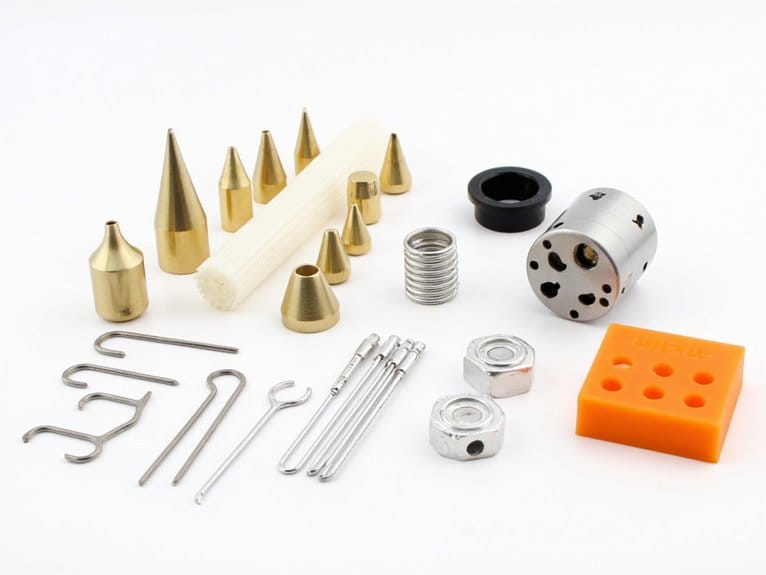
Every 3D printer will eventually require replacement parts to maintain peak performance, making a well-stocked inventory of essential components crucial for minimizing downtime.
You’ll need specific hardware categories to keep your machine operational.
Essential replacement parts include:
- Motherboard upgrades – 32-bit processors outperform 8-bit versions for G-code processing, while stepper drivers control axis movement precision.
- Extruder enhancements – Nozzles in various diameters (0.2mm-1.0mm), heater cartridges, and PTFE guide tubes guarantee consistent filament flow.
- Motion components – Linear bearings, belts, pulleys, and endstop switches maintain accurate positioning and prevent mechanical failures.
- Build surface hardware – Heated bed elements, PEI sheets, leveling springs, and BLTouch sensors optimize first-layer adhesion.
Stock fuses, ribbon cables, and terminal connectors for electrical repairs.
These components prevent extended printer downtime when failures occur.
On a final note
You’ll maximize your 3D printing success by investing in these essential accessories. Quality filament storage prevents moisture damage. Upgraded nozzles improve print precision. Proper bed adhesion tools eliminate first-layer failures. Post-processing equipment delivers professional results. Measurement tools guarantee accuracy. Organized workspaces boost efficiency. Temperature control maintains consistent performance. Keep replacement parts stocked for minimal downtime. These accessories transform basic printers into reliable production systems that consistently deliver high-quality prints.