We are supported by our audience. When you purchase through links on our site, we may earn an affiliate commission, at no extra cost for you. Learn more. Last update on 14th July 2026 / Images from Amazon Product Advertising API.
You don’t strictly need an airbrush cleaning pot, but it’s essential for serious work. This specialized container captures paint and solvents during maintenance, reducing VOC exposure by 40-60% while preventing workspace contamination. It enables 30-45 second color changes versus several minutes with traditional cleaning methods, while protecting your airbrush from corrosive buildup that damages internal components. Commercial models cost $15-30, though DIY versions work for under $5. Professional applications across automotive, fine arts, and food decoration demonstrate their practical value for consistent results.
Notable Insights
- Cleaning pots reduce health risks by minimizing exposure to paint fumes and toxic solvents during airbrush maintenance.
- They enable faster color changes in 30-45 seconds and reduce cleanup time for improved workflow efficiency.
- Regular use prevents paint buildup and internal corrosion, extending airbrush lifespan and reducing costly component replacements.
- Universal designs work with all airbrush types and brands, featuring adaptable holders and weighted bases for stability.
- Cost-effective investment at $15-$30 commercially or under $5 for DIY versions, reducing paint waste by 50%.
What Is an Airbrush Cleaning Pot and How Does It Work?
An airbrush cleaning pot is a specialized container system that captures paint and solvents during airbrush maintenance, preventing contamination of your workspace.
The device consists of a glass or plastic jar with a fitted lid containing an airbrush holder and cleaning cup reservoir.
A complete cleaning station featuring a secure jar, fitted lid, airbrush holder, and integrated cleaning cup reservoir for efficient maintenance.
You insert your airbrush nozzle into the holder, fill the cup with appropriate cleaning solution, then trigger paint and solvent through the system. The pot captures expelled materials while replaceable filters trap overspray and debris.
This setup works effectively with all airbrush types, from gravity-feed to siphon models.
The cleaning techniques remain consistent: spray cleaning fluid through the airbrush until it runs clear. Components like a glass cleaning pot with a leak-proof lid prevent evaporation of your cleaning solutions.
This process eliminates tedious sink trips while maintaining peak airbrush performance across color changes. These versatile tools often feature a 3-in-1 design that serves as cleaning station, airbrush holder, and color palette. A complete cleaning system typically includes additional accessories like wash needles and cleaning brushes to ensure thorough maintenance. Glass constructions are preferred over plastic options due to their superior durability and resistance to paint chemicals.
Many cleaning pots feature integrated water traps that separate moisture from compressed air, protecting your airbrush system from contamination.
Workspace Protection and Mess Prevention Benefits
Most airbrush cleaning pots eliminate workspace contamination by capturing paint overspray within a sealed containment system. The tight-sealing lid prevents paint splattering on surrounding surfaces while maintaining workspace cleanliness.
Filter elements in advanced models absorb vapors and reduce paint mist diffusion throughout your work area.
You’ll benefit from three key protection advantages:
- Overspray containment prevents paint stains on furniture, floors, and equipment
- Vapor filtration improves air quality in enclosed spaces
- Spill prevention eliminates cleanup of scattered paint droplets
Your workspace organization improves markedly with dedicated overspray containment.
The weighted base provides stable airbrush storage during cleaning cycles. Similar to how metal dice sets offer enhanced stability through their substantial weight, cleaning pots with weighted bases prevent tipping during operation. You’ll avoid paint damage to electronic devices and sensitive equipment nearby. Contained cleaning reduces slipping hazards while preserving work surface integrity. The lightweight construction makes these units easily portable between different workstations.
Professional airbrush maintenance often involves ultrasonic cleaners that operate at optimal frequencies between 40-48kHz for thorough paint removal from delicate components. Many cleaning systems feature non-toxic formulations that reduce health risks in home studio environments. Proper maintenance ensures your airbrush continues operating within the optimal pressure range of 20 to 55 PSI for consistent performance.
Health and Safety Advantages for Artists
Beyond protecting your workspace from contamination, cleaning pots deliver substantial health and safety benefits that directly impact your well-being as an artist.
The enclosed design prevents paint fumes from escaping into your breathing zone, reducing inhalation of volatile organic compounds (VOCs) from solvents and pigments. This containment system minimizes airborne paint droplets and vapor exposure that can cause long-term respiratory hazards.
Artist health improves through reduced skin contact with toxic substances, including heavy metals found in certain paints.
The closed cleaning system prevents accidental splashes and contamination that lead to skin irritation or allergic reactions. Solvent handling becomes markedly safer as the pot contains evaporation and dispersal of flammable vapors.
This containment supports safety standards for hazardous material handling while creating ergonomic workflows that reduce accident risks.
Workflow Efficiency and Time-Saving Features
While health benefits provide compelling reasons to invest in cleaning pots, the workflow improvements deliver immediate practical value that transforms your airbrushing efficiency. These closed containers enable hands-free operation through integrated airbrush rests, allowing simultaneous preparation of next colors or tool adjustments.
The workflow optimization benefits include:
- Faster color changes – Complete purging cycles in 30-45 seconds versus 2-3 minutes with traditional methods.
- Reduced cleanup time – Contained overspray eliminates workspace contamination requiring post-session cleaning.
- Uninterrupted painting flow – Consistent cleaning speed maintains momentum during multi-layer projects.
Specialized filters and compatible cleaning fluids enhance performance by preventing clogs that cause workflow disruptions.
The standardized cleaning process supports production environments where predictable timing matters. This reliability translates directly into completed projects and reduced rework cycles.
Airbrush Maintenance and Longevity Benefits
The cleaning pot’s greatest long-term value lies in protecting your airbrush investment through superior maintenance capabilities. Your equipment experiences considerably less internal corrosion when you thoroughly remove paint residue after each session.
The pot facilitates complete rinsing that prevents clogs in critical components like needles and nozzles. Different cleaning solutions work more effectively in a contained environment. You’ll achieve deeper cleaning than spraying onto open surfaces or paper towels.
This thorough removal prevents dried paint buildup that damages internal mechanisms over time. Your airbrush maintains ideal spray quality when contaminants can’t accumulate. Water-based paints with non-toxic formulations clean more easily with simple soap and water solutions. Regular cleaning is essential to prevent clogs and maintain performance across all airbrush models. Proper workspace illumination with adjustable brightness settings helps you inspect your airbrush thoroughly during cleaning sessions.
Professional airbrush techniques require consistent performance, which depends on regular maintenance. The cleaning pot extends intervals between major overhauls while preserving needle and nozzle integrity through systematic residue removal. Models with spring-steel needles benefit especially from proper cleaning protocols, as these durable components resist breakage when maintained correctly.
Cost Savings and Environmental Impact
Although initial cleaning pot costs might seem unnecessary, you’ll recover this investment through multiple savings streams that compound over time. Commercial cleaning pots range from $15-$30, while DIY versions cost under $5 using household containers. Your cost efficiency improves through three primary mechanisms:
- Solvent conservation – Contained cleaning reduces evaporation losses by 40-60% compared to open containers.
- Paint waste reduction – Quick color changes require 50% less paint volume for flushing.
- Equipment longevity – Proper residue management prevents costly airbrush component replacements.
Beyond financial benefits, you’re supporting ecological responsibility. Fabric filters capture paint particles before disposal, preventing drain contamination.
VOC emissions decrease greatly through enclosed cleaning systems. This controlled waste management protects waterways from heavy metals and chemical compounds while maintaining regulatory compliance in your workspace. The water-based formulas found in most modern airbrush paints also contribute to safer disposal processes compared to traditional solvent-based alternatives.
Essential Setup and Maintenance Requirements
You’ll need to replace filters and foam pads regularly to maintain effective vapor trapping and prevent solvent contamination in your workspace.
The rubber seals around the nozzle port require periodic inspection for cracks or wear that could cause leaks and reduce cleaning efficiency.
Maintaining these components properly guarantees your cleaning pot operates at peak performance and extends the lifespan of both the pot and your airbrush system.
Proper Filter Replacement
When your airbrush cleaning system‘s filters become saturated with paint particles and overspray, replacing them properly guarantees continued protection for both your workspace and your health.
Effective filter selection depends on your booth type and usage frequency. MERV 8 filters handle standard applications, while MERV 13 filters provide superior particle capture for demanding projects.
Follow these installation tips for maximum performance:
- Check orientation arrows – Installing filters backward reduces efficiency by 40-60%
- Replace entire filter kits simultaneously – Mixed filter ages compromise airflow balance
- Verify airtight sealing – Gaps allow particles to bypass filtration media
Clean booth interiors before installation to prevent contamination transfer.
Washable pre-filters offer cost-effective frequent replacement, while disposable MERV filters require proper hazardous waste disposal due to paint residue content.
Seal Maintenance Tips
Although airbrush seals represent small components, they’re critical for maintaining consistent spray patterns and preventing costly paint leakage that compromises your finished work.
Proper lubrication techniques require manufacturer-recommended lubricant applied sparingly-typically one drop on O-rings and needle packing when movement feels stiff. Over-lubrication causes paint contamination and buildup within seals.
Monitor seal wear by checking O-rings for cracks, flattening, or brittleness during routine maintenance. Replace seals immediately if paint leaks or air bubbles appear in your paint cup during trigger operation.
Remove needles and handles before applying lubricant to prevent damage. Tighten nozzle caps finger-tight only to preserve thread integrity. Clean threads with soft-bristle brushes during maintenance sessions.
Avoid harsh solvents that degrade delicate seals, and flush promptly after use to prevent abrasive cleaning requirements.
Professional Applications and Use Cases
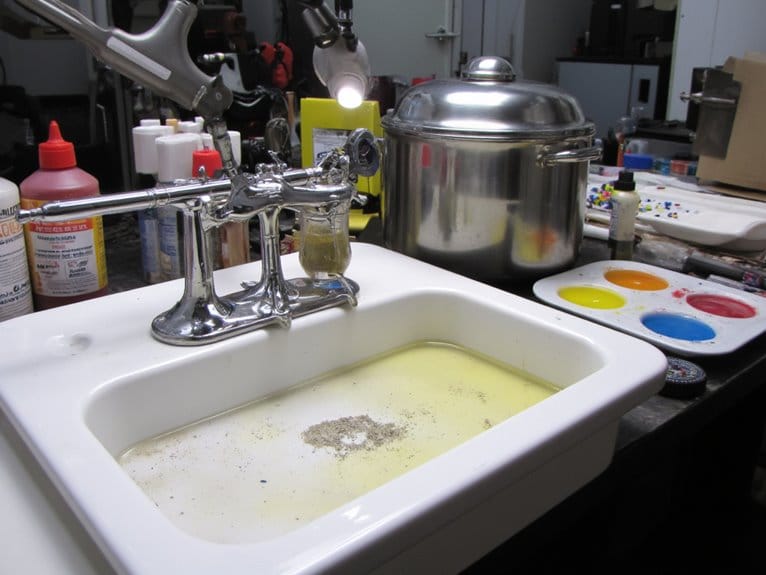
You’ll find airbrush cleaning pots aren’t just hobby accessories-they’re critical equipment across multiple professional industries where precision and cleanliness directly impact final results.
Whether you’re working in automotive paint booths applying base coats and clearcoats, managing multiple pigments in fine arts studios, or decorating delicate pastries with food-grade colorants, contamination control becomes essential for quality output.
These specialized environments demand consistent color accuracy and surface finish quality that’s only possible when your airbrush maintains peak performance between applications.
Automotive Paint Finishing
Professional automotive paint finishing demands precision that separates quality work from amateur results.
You’ll need exceptional spray consistency and color accuracy when working on collision repairs, custom graphics, or multi-coat applications.
Cleaning pots become essential tools for maintaining these standards throughout your workflow.
Your automotive paint shop benefits from cleaning pots in three critical areas:
- Touch-up work – Quick color changes without cross-contamination
- Multi-coat systems – Clean shifts between primers, base coats, and clear coats
- Custom applications – Precise cleaning for detailed graphics and specialty finishes
You’ll extend your airbrush lifespan while reducing downtime between colors.
The controlled cleaning environment prevents paint buildup that causes spray pattern inconsistencies.
Professional shops rely on this equipment to meet manufacturer finish specifications and maintain workflow efficiency during high-volume operations.
Fine Arts Studios
When fine art demands precision beyond traditional brushwork, airbrush cleaning pots become indispensable studio equipment for maintaining professional-grade results.
You’ll prevent color contamination during detailed illustration and character design work. The contained environment captures expelled paint residue while you flush solvents through your airbrush mechanism.
Most cleaning pots include replaceable filters that trap paint particles during operation. You’ll extend your airbrush’s lifespan by preventing corrosion from neglected cleaning routines.
The integrated holder component secures your tool between color changes, streamlining multilayered painting techniques.
Advanced models feature caps doubling as paint mixing palettes, supporting various airbrush techniques. You’ll reduce cleaning time compared to manual methods while maintaining peak spray quality.
Professional studios benefit from improved workflow efficiency and reduced environmental contamination during continuous workshop use. Regular cleaning is especially critical with cordless airbrush kits where proper maintenance ensures optimal performance and prevents the clogging issues commonly reported by users.
Commercial Food Decoration
In commercial food decoration environments, airbrush cleaning pots aren’t just convenient accessories-they’re essential safety equipment that prevents cross-contamination between edible colors and maintains regulatory compliance.
Professional bakeries and confectionery operations demand precise cake decoration standards. Cleaning pots contain overspray and cleaning fluids, protecting sensitive compressor components from sticky cocoa butter residues.
Your workflow efficiency depends on quick color changes without contamination risks.
Critical applications requiring cleaning pots include:
- High-volume bakeries switching between multiple edible colors throughout production shifts
- Custom cake decorators using intricate stencils and gradient airbrush techniques requiring spotless equipment
- Chocolate manufacturers working with temperature-sensitive cocoa butter sprays that solidify quickly
These systems reduce downtime by enabling in-pot cleaning without equipment disassembly. Food-grade materials guarantee regulatory compliance while filtered designs protect expensive compressor systems from particulate damage.
On a final note
You’ll find an airbrush cleaning pot isn’t just convenient-it’s essential for serious work. The workspace protection, health benefits, and equipment longevity make it a smart investment. You’ll save time during color changes and reduce paint waste substantially. Whether you’re doing hobby projects or professional illustration, a cleaning pot streamlines your workflow and protects your airbrush investment. It’s a tool that pays for itself through improved efficiency and reduced maintenance costs.