We are supported by our audience. When you purchase through links on our site, we may earn an affiliate commission, at no extra cost for you. Learn more. Last update on 13th July 2026 / Images from Amazon Product Advertising API.
You’ll primarily use 90% isopropyl alcohol (IPA) to clean standard resin prints, while water-washable resins require only tap water. For enhanced cleaning power, consider ethyl acetate or commercial washing solutions, though they cost more. You’ll need nitrile gloves, safety goggles, and proper ventilation when handling solvents. Use a two-bath system: first bath removes heavy residue, second provides final cleaning. Ultrasonic cleaners improve precision for complex geometries. The specific cleaning method depends on your resin type and available equipment options.
Notable Insights
- Use 90% isopropyl alcohol (IPA) for standard resins or plain tap water for water-washable resins.
- Implement a double bath system: first bath removes bulk resin, second clean bath provides final rinse.
- Wear nitrile gloves and safety goggles while ensuring proper ventilation to protect from chemical exposure.
- Use ultrasonic cleaners and soft brushes to remove stubborn residue from complex geometries and support areas.
- Replace contaminated cleaning solutions regularly and inspect prints for glossiness to ensure complete resin removal.
Common Solvents and Cleaning Agents for Resin Prints
Several effective solvents and cleaning agents exist for post-processing resin 3D prints, each offering distinct advantages and limitations.
Isopropyl alcohol (IPA) at 90% concentration remains the most widely used option due to its accessibility and proven cleaning efficiency.
IPA’s widespread adoption stems from its perfect balance of effectiveness, affordability, and availability for resin print cleaning.
You’ll find ethyl acetate delivers superior dissolving power for stubborn residue but costs more than standard IPA.
For solvent comparison, tripropylene glycol monomethyl ether offers reduced odor and flammability while propylene glycol diacetate provides gentler handling properties.
Water-washable resins eliminate organic solvents entirely, requiring only frequent water changes.
Denatured alcohol provides an affordable alternative to IPA while effectively dissolving uncured resin, though it may produce slight tinting effects on prints.
Each agent requires specific safety protocols – IPA needs ventilation and protective gloves, while specialized butyl gloves work best with ethyl acetate.
Your choice depends on print material, safety requirements, and budget considerations. Multiple solvent options provide flexibility in cleaning for users with different sensitivities and workspace requirements.
Essential Tools and Equipment for Effective Cleaning
Essential cleaning accessories include nitrile gloves, safety goggles, and respiratory masks with appropriate filters. These protect you from chemical exposure during resin maintenance procedures.
Silicone mats with raised lips contain spills while resisting resin adhesion. Standard flush cutters remove supports effectively, though ultrasonic cutters like the Phrozen Sonic Saber provide superior precision through high-frequency vibrations.
Ultrasonic cleaner tanks require mesh baskets to prevent print damage and guarantee proper solution circulation. Nonflammable cleaners like Mean Green are suitable alternatives for ultrasonic cleaning applications. These devices typically operate at frequencies between 20kHz to 60kHz to effectively clean intricate print details.
Fresh isopropyl alcohol solutions maintain peak cleaning effectiveness. Tongs handle prints safely during rinses, while lint-free cloths prevent spotting.
Many users report that proper ventilation systems significantly reduce exposure to cleaning fumes and improve overall workspace safety.
UV curing stations complete the polymerization process post-cleaning, guaranteeing proper resin hardening for ideal print durability. Ultrasonic cleaners with SUS 304 stainless steel tanks provide enhanced corrosion resistance when used with aggressive solvents.
Water-Washable Resin Cleaning Methods
Water-washable resins eliminate many complexities found in traditional resin cleaning workflows.
You’ll use plain tap water as your primary cleaning agent, taking advantage of the unique water resin interaction that dissolves uncured material without harsh solvents.
Start with two clean water buckets for sequential washing.
Agitate your model for 1-3 minutes in the first bucket, then transfer to the second for another 1-3 minutes.
This dual-stage process maximizes cleaning efficiency while preventing cross-contamination.
An ultrasonic cleaner provides the final 3-minute rinse, reaching intricate details conventional washing misses.
Dry thoroughly using compressed air, paying special attention to hollow sections.
Optional mild detergent or low-concentration isopropyl alcohol enhances stubborn residue removal when needed.
Step-by-Step Cleaning Process for Standard Resins
Standard resin prints require a methodical solvent-based cleaning approach that differs greatly from water-washable alternatives. You’ll need 90% or higher isopropyl alcohol for effective uncured resin removal.
| Stage | Duration | Purpose |
|---|---|---|
| First Bath | 1-3 minutes | Remove heavy uncured resin |
| Brushing | 30-60 seconds | Loosen stubborn residue |
| Second Bath | 1-3 minutes | Final cleaning |
Start with used IPA for your initial wash, agitating the print continuously. Use soft brushes during this stage for cleaning artifacts like support marks. Transfer to clean IPA for your second wash cycle. Additional washing may be necessary if sticky spots remain visible.
Dry thoroughly with compressed air for 10-15 minutes, focusing on internal channels. Inspect for remaining glossy areas indicating incomplete cleaning before proceeding to post-curing.
Ultrasonic Cleaning Techniques and Benefits
Three key advantages make ultrasonic cleaning the preferred method for achieving professional-grade resin print finishes: superior cleaning consistency, reduced handling time, and enhanced safety compared to manual techniques.
High-frequency sound waves generate cavitation bubbles that implode microscopic debris from intricate surfaces. This ultrasonic frequency penetration reaches areas impossible to clean manually. Set temperatures between 30°C and 50°C for ideal results during 5-10 minute cycles.
Ultrasonic cavitation bubbles implode debris from intricate surfaces that manual cleaning cannot reach, achieving superior professional results.
You’ll need proper solution placement for safety. Place IPA in sealed bags submerged in water rather than directly in heated tanks. Use 91% IPA concentration for balanced cleaning power and cost-effectiveness.
Follow this workflow: pre-rinse prints, ultrasonic clean in prepared solution, then post-rinse thoroughly. Remove supports after cleaning to prevent interference.
Air dry 12-24 hours before handling finished prints.
Post-Cleaning Procedures and Surface Preparation
Once ultrasonic cleaning completes, proper rinsing becomes critical for removing dissolved resin residue and preparing surfaces for UV curing. Use 90-99% isopropyl alcohol in a two-stage wash system. First bath dissolves remaining resin, while the second removes residue completely.
| Stage | Solution | Duration |
|---|---|---|
| Initial Rinse | Fresh IPA 90-99% | 2-3 minutes |
| Final Rinse | Clean IPA 90-99% | 2-3 minutes |
| Drying | Air dry at room temp | Until completely dry |
These post cleaning techniques guarantee ideal surface preparation. Agitate prints manually or use wash stations for enhanced effectiveness. Air dry thoroughly before UV curing to prevent surface defects. Inspect for residual uncured resin and clean any remaining spots. Use lint-free cloths or compressed air for detailed areas. Complete drying prevents cloudiness during curing.
Safety Precautions When Handling Cleaning Chemicals
Working with resin cleaning chemicals demands strict adherence to safety protocols, as these substances can cause serious health issues through skin contact, inhalation, or eye exposure.
Always wear chemical-resistant nitrile or neoprene gloves with extended cuffs for wrist protection. Safety glasses prevent splashing into your eyes during cleaning operations.
Chemical-resistant gloves with extended cuffs and safety glasses are essential protective equipment when handling resin cleaning solvents.
Maintain excellent ventilation using exhaust fans or open windows to disperse harmful vapors. Keep your workspace separate from living areas to minimize contamination risks.
Chemical safety requires using only isopropyl alcohol, ethanol, or manufacturer-recommended solvents according to their safety data sheets.
For spill prevention, cover work surfaces with disposable plastic liners and keep absorbent rags nearby.
Never use cleaning solvents near heat sources or flames due to flammability risks. Store all chemicals in cool, labeled containers away from UV light.
When using ultrasonic cleaners for resin print cleaning, ensure your workspace maintains the same safety standards as these devices often require heating cleaning solutions to temperatures between 70-175°F.
Cleaning Complex Geometries and Internal Channels
After establishing proper safety protocols, you’ll encounter your greatest cleaning challenge: removing uncured resin from complex internal geometries, hollow channels, and intricate details that manual cleaning can’t reach.
Ultrasonic effectiveness becomes critical here, as high-frequency sound waves create cavitation bubbles that penetrate intricate spaces manual methods can’t access.
Understanding cleaning intricacies requires multiple approaches:
- Pre-rinse prints in isopropyl alcohol before ultrasonic cleaning to remove loose resin
- Use mesh baskets to suspend parts, preventing contact with tank bottom damage
- Inject cleaning solvents directly into internal cavities using syringes or pipettes
- Apply compressed air to dislodge trapped resin droplets after solvent washing
For highly complex geometries, combine gentle agitation with circulating IPA wash stations.
Fresh alcohol maintains cleaning efficacy while preventing resin redeposition in internal voids.
Choosing the Right Cleaning Method by Resin Type
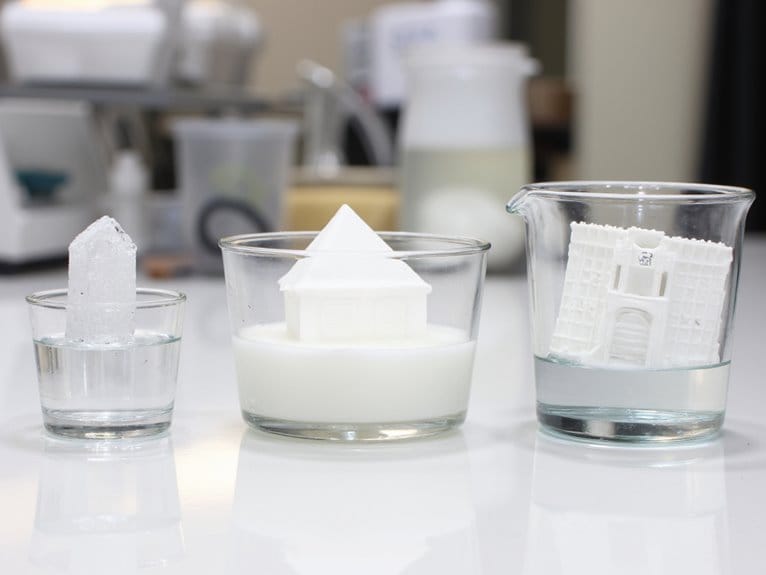
Your choice of cleaning method depends entirely on the type of resin you’re using for your 3D prints.
Standard resins require solvent-based cleaning with isopropyl alcohol or alternative solutions like TPM, while water-washable resins can be cleaned with simple tap water rinses.
Understanding your resin’s chemistry determines whether you’ll need hazardous solvents or can use safer water-based cleaning processes.
Standard Resin Cleaning
When you’re cleaning standard resin prints, selecting the appropriate cleaning method depends heavily on your specific resin formulation, available equipment, and safety requirements.
IPA remains the most widely used solvent, with concentrations from 70% to 99% effectively dissolving uncured resin residue. Higher purity IPA delivers faster, cleaner results but requires careful ventilation due to flammability concerns.
Consider these cleaning techniques based on resin compatibility:
- IPA washing: Best for general standard resins, requires frequent solution replacement
- Commercial washing solutions: Longer-lasting, lower odor, reduced fire hazards
- Ultrasonic cleaning: Enhanced efficiency for detailed prints using non-flammable solvents
- Alternative solvents: Mean Green or specialized detergents for safety-conscious applications
Always verify chemical compatibility with your specific resin material to prevent surface damage or compromised print quality. Many modern resins feature easy cleaning formulations that reduce post-processing time and simplify solvent removal.
Water-Washable Resin Processing
Troubleshooting Common Cleaning Problems and Surface Issues
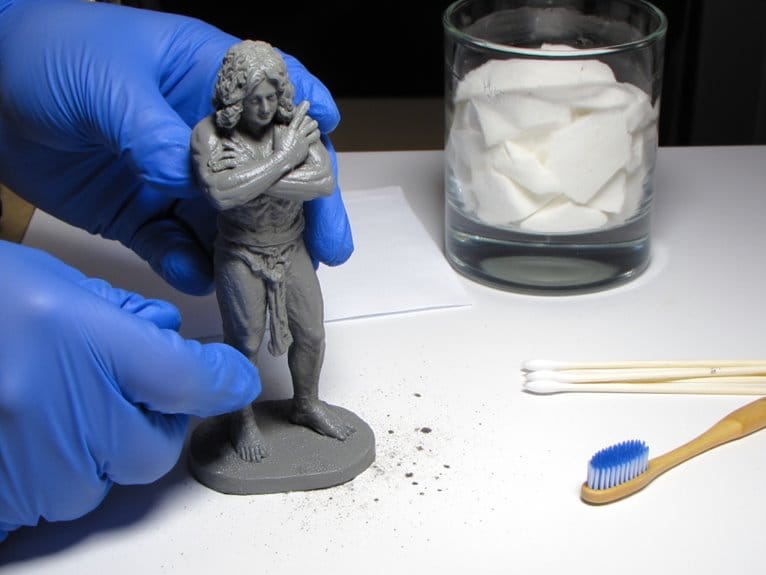
Even with proper cleaning techniques, you’ll encounter common surface issues that require specific troubleshooting approaches.
Persistent surface stickiness typically indicates incomplete resin removal or contaminated cleaning solutions that leave residual uncured material on your prints.
Understanding these three main problem areas-surface stickiness, incomplete removal, and solution contamination-will help you identify the root cause and apply the correct fix to achieve professional-quality results.
Persistent Surface Stickiness
Most resin prints develop persistent surface stickiness due to incomplete removal of uncured resin during the washing process or inadequate UV post-curing that leaves reactive polymer chains unfinished.
This sticky residue forms when oxygen interferes with surface curing or when contaminated washing solutions fail to dissolve uncured particles effectively.
The print surface requires thorough decontamination to eliminate tackiness:
- Re-wash immediately in fresh isopropyl alcohol using soft brush scrubbing to remove partially cured spots.
- Perform multiple IPA rinses with brushing between cycles to break down stubborn residues.
- Extend UV post-curing time using manufacturer specifications to fully polymerize surface resin.
- Ensure complete drying between washing and curing steps to prevent water contamination.
If stickiness persists, repeat washing cycles with slightly heated IPA or consider mechanical removal for localized problem areas.
Incomplete Resin Removal
When uncured resin remains embedded in surface details or trapped within complex geometries after standard washing procedures, you’re dealing with incomplete resin removal that requires systematic troubleshooting to identify the root cause.
Insufficient exposure time creates weak incomplete layer structures where resin doesn’t fully polymerize. Check your printer’s calibration settings and adjust exposure parameters accordingly.
Contaminated resin vats with cured particles block UV light transmission, preventing proper curing. Clean your vat thoroughly with recommended solvents and inspect the FEP film for scratches.
Degraded resin properties from improper storage cause inconsistent curing patterns. Replace old resin and guarantee proper UV-shielded storage.
Increase washing time using fresh isopropyl alcohol, then perform additional UV post-curing to complete the polymerization process.
For optimal polymerization results, maintain proper curing temperature conditions as ambient temperatures below 72-75°F can significantly impact resin efficiency and completeness of the curing process.
Cleaning Solution Contamination
Although cleaning solutions appear clear initially, they quickly become contaminated with uncured resin particles that compromise your print’s final surface quality.
Dirty IPA baths accumulate residue from previous prints, creating contamination risks that manifest as white haze, surface stickiness, or uneven finishes. Reusing solutions without proper filtration reduces cleaning efficacy dramatically.
Effective contamination prevention requires a systematic approach:
- Implement double bath system – Use initial dirty bath for bulk removal, clean bath for final rinse
- Replace solutions regularly – Filter IPA to remove suspended particles and maintain performance
- Separate resin types – Avoid cross-contamination between different resin formulations
- Store properly – Keep solutions sealed away from light and airborne contaminants
When white residues persist despite fresh solutions, increase rinse duration or switch to specialized cleaners formulated for reduced contamination buildup.
On a final note
You’ve got multiple cleaning options for resin prints, from IPA and acetone to water-washable methods. Choose your solvent based on your resin type and safety requirements. Use ultrasonic cleaners for complex geometries. Always wear proper PPE when handling chemicals. Clean prints immediately after printing for best results. Water-washable resins offer the safest option but may compromise detail quality. Match your cleaning method to your specific resin manufacturer’s recommendations for best surface finish.