We are supported by our audience. When you purchase through links on our site, we may earn an affiliate commission, at no extra cost for you. Learn more. Last update on 11th June 2026 / Images from Amazon Product Advertising API.
You’ll start your Warhammer 40K journey by selecting a faction that matches your tactical preferences-Space Marines offer balanced gameplay for beginners, while Necrons emphasize durability and T’au focus on ranged combat. Purchase the free core rules from Games Workshop’s website, then acquire your first army through starter sets or individual units. Learn the six-phase turn structure: Command, Movement, Psychic, Shooting, Fight, and Battle-shock phases. Master dice-based combat resolution using D6 rolls for hits, wounds, and saves. Connect with local hobby stores for games and community events that’ll reveal advanced strategies.
Notable Insights
- Start with Space Marines as they offer balanced gameplay, strong community support, and are beginner-friendly compared to other factions.
- Learn the structured battle rounds with six phases: Command, Movement, Psychic, Shooting, Fight, and Battle-shock for effective gameplay.
- Use proper tools like plastic clippers and hobby knives to assemble miniatures, then prime and paint in thin layers.
- Access free core rules on Games Workshop’s website and engage with local hobby stores for hands-on experience.
- Choose your first army based on aesthetic appeal and tactical preferences while considering your budget for initial investment.
Understanding the Basics of Warhammer 40K
Before you can command armies across the grim darkness of the 41st millennium, you’ll need to master Warhammer 40K’s core mechanics and game structure.
Games consist of battle rounds where both players alternate turns through six distinct phases: Command, Movement, Psychic, Shooting, Fight, and Battle-shock. Combat follows a five-step resolution process using your units’ characteristics against enemy stats.
Your army composition determines faction synergy and affects gameplay strategies notably.
Mission objectives drive competitive play scenarios, while narrative campaigns offer structured lore exploration. Each turn requires resource management of Command Points for strategic advantages.
Scenario planning involves understanding Strength versus Toughness ratios, save characteristics, and damage allocation. Victory is achieved by accumulating victory points as per mission objectives rather than simply eliminating enemy forces.
The hobby extends beyond gaming through painting techniques and building detailed armies for both casual and tournament environments. The 10th edition has introduced improved gameplay mechanics that enhance the overall strategic depth and player engagement compared to previous versions.
Choosing Your First Faction and Army
Your faction choice shapes every aspect of your Warhammer 40K experience, from gameplay mechanics to painting projects.
Three super-factions define the universe: Imperium of Man, Chaos, and Xenos aliens. Each offers distinct army playstyle options and tactical approaches.
Space Marines provide excellent beginner strategies with balanced, resilient troops and extensive community support. Their tactical flexibility suits newcomers learning core mechanics.
Necrons offer durability through regeneration abilities, while T’au Empire emphasizes ranged firepower tactics.
Consider faction lore carefully. Imperium factions represent human resilience and imperial dedication. Chaos embodies corruption and dark powers. Xenos deliver diverse alien aesthetics from insectoid Tyranids to technologically advanced civilizations.
Aesthetic appeal greatly influences long-term engagement. Visual miniature design affects painting motivation and collecting enthusiasm. Over 20 unique factions are available across the Warhammer 40K universe, providing extensive variety in themes and gameplay styles.
Avoid complex armies like Harlequins initially. Choose factions matching your tactical preferences and thematic interests for sustained enjoyment.
Essential Resources and Where to Find Them
Once you’ve selected your faction, acquiring the right resources becomes critical for building your army and developing your skills. Games Workshop’s official website provides starter sets containing miniatures, paint, and dice. These Starter Set Recommendations include two armies and terrain for complete battles.
| Resource Type | Primary Sources | Key Benefits |
|---|---|---|
| Official Rules | Games Workshop website | Free core rules, tutorials |
| Physical Products | Local hobby stores | Hands-on experience, workshops |
| Learning Materials | YouTube channels, wikis | Video tutorials, tactical guides |
| Painting Supplies | Official stores, online retailers | Color-accurate paints, beginner sets |
| Community Support | Game nights, forums | Personalized advice, practical experience |
Essential Online Resources include Warhammer 40K Wiki for thorough unit data and “No Static” YouTube channel for 10th edition tutorials. Local stores offer painting workshops and community connections. For those interested in diving deeper into the lore, essential novels like Hero of the Imperium serve as excellent entry points that introduce major factions while balancing humor with the universe’s darker themes.
Learning Core Gameplay Mechanics
You’ll master three core mechanics that form the foundation of every Warhammer 40K battle: the structured phase system that governs turn sequence, the dice-based statistics that determine unit capabilities and combat outcomes, and the special rules that modify standard gameplay interactions.
Understanding game phases means knowing when you can move, shoot, charge, and fight during each battle round, while dice mechanics involve comparing your unit’s weapon strength against enemy toughness values on D6 rolls.
Special rules mastery requires learning how abilities like “Assault,” “Heavy,” and “Rapid Fire” modify weapon performance, plus faction-specific rules that give your army unique tactical advantages.
Game Phase Structure
While Warhammer 40K features complex armies and lore, the actual gameplay follows a structured five-phase turn sequence that’s surprisingly straightforward to learn.
Each turn begins with the Command Phase, where you’ll gain one Command Point and test Battle-shocked units using 2D6 against their Leadership value.
The Movement Phase lets you reposition units within their movement allowances, though advancing restricts shooting capabilities.
During the Shooting Phase, non-advancing units can target enemies within range and line-of-sight.
The Charge Phase requires rolling 2D6 to close distance for melee combat.
Finally, the Fight Phase resolves close combat between engaged units.
Understanding these phase interactions enables effective game strategies and tactical decision-making throughout each battle turn.
Dice and Stats
Behind every tactical decision in Warhammer 40,000 lies a dice-driven system that transforms unit statistics into concrete battlefield outcomes. You’ll primarily use six-sided dice (D6) to resolve hits, wounds, saves, and morale tests. Each model’s weapon profile determines how many dice you roll-five Space Marines with bolters generate ten dice rolls total.
Understanding dice mechanics means grasping probability fundamentals. Rolling 4+ succeeds 50% of the time (three outcomes out of six). Modifiers stack mathematically: division, multiplication, addition, then subtraction. Always round fractional results up.
Your probability strategies should account for statistical variance. Multiple dice compound uncertainty, creating clustering effects that can swing battles. Command re-rolls provide tactical insurance for critical moments, allowing one dice reroll before applying modifiers.
Special Rules Mastery
Special rules mastery transforms scattered mechanics knowledge into cohesive tactical understanding that drives effective battlefield command.
You’ll encounter special abilities on weapon profiles and unit datasheets that modify core mechanics. Anti-infantry weapons wound infantry targets more easily. Anti-vehicle weapons bypass armor saves against vehicles. Critical hits on rolls of 6 trigger additional damage or mortal wounds.
Command Points fuel Stratagems that provide strategic advantages during pivotal moments. You can reroll failed hit rolls, ignore movement penalties, or activate out-of-sequence abilities. Each faction offers unique Stratagems tailored to their combat doctrine.
Movement restrictions create tactical decisions. Advanced units can’t shoot non-Assault weapons. Units in Engagement Range must Fall Back before shooting.
These interactions between special rules determine battlefield positioning and timing of your tactical decisions.
Building and Painting Your Miniatures
The assembly and painting process transforms plastic sprues into battlefield-ready armies that represent your chosen faction’s aesthetic and tactical role. Miniature assembly requires careful planning and proper technique execution.
Remove components from sprues using plastic clippers, then clean mold lines with hobby knives. Plan your build sequence to create subassemblies for easier painting access.
Painting techniques build upon proper foundation work. Prime all surfaces with thin, even coats to guarantee paint adhesion.
Foundation preparation determines paint quality – proper priming creates the essential base layer for achieving professional-looking results on miniature surfaces.
Apply base colors in multiple thin layers rather than single thick applications. Use washes in recesses for depth, then highlight raised areas for definition.
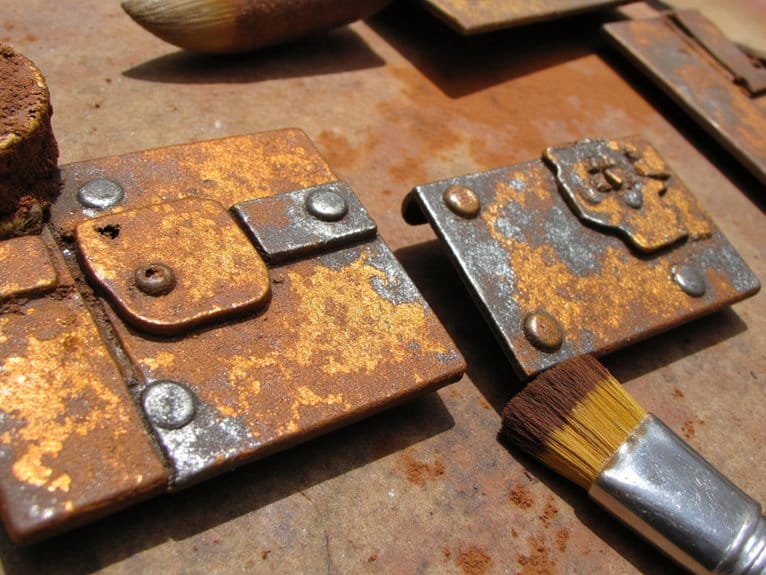
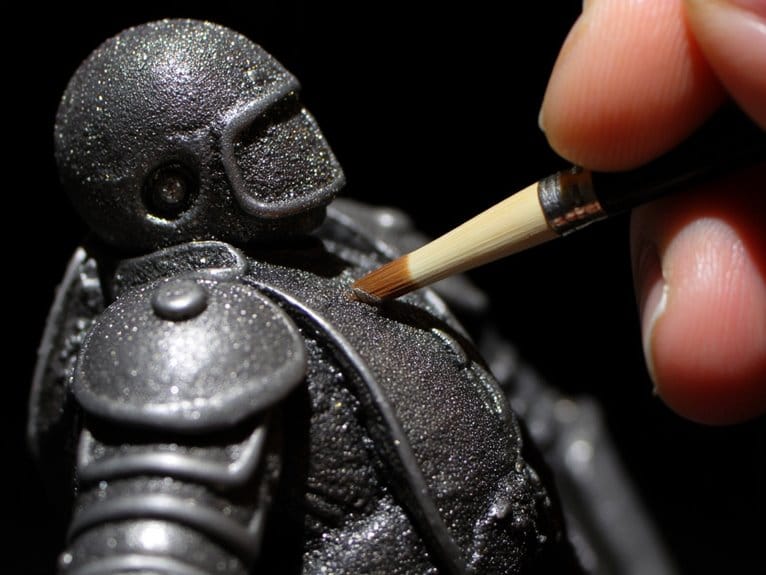
For weathering effects and metallic finishes, specialized dry brushes with dome-shaped tips excel at creating realistic battle-worn appearances on your miniatures. High pigmentation paints provide the best coverage and color intensity for achieving professional-looking results on your Warhammer 40K models.
When attaching your painted miniatures to bases, use CA glues for instant bonding that cures within 2-5 seconds for secure adhesion. For detailed work like drilling weapon barrels or creating pin joints, a pin vise provides the manual precision control needed for these intricate modifications.
- Remove sprues carefully with plastic clippers to prevent damage
- Prime models completely before applying any base colors
- Build color intensity through multiple thin paint layers
- Apply washes strategically in recessed areas only
- Seal finished models with protective varnish coating
Connecting With the Warhammer Community
Building your miniature army represents only half of the Warhammer 40K experience-engaging with the passionate community surrounding this hobby will enhance your enjoyment and accelerate your learning curve markedly.
Local Game Stores serve as primary entry points for most players. These venues host weekly matches, beginner tournaments, and painting workshops that facilitate direct integration into established player networks.
You’ll find extensive online resources through platforms like Reddit’s r/Warhammer40k, Discord servers, and official forums. These digital spaces provide real-time strategy discussions, painting tutorials, and matchmaking opportunities.
Social media platforms including Instagram and YouTube showcase painted miniatures while connecting you to influential hobbyists.
Community events range from local club meetings to major conventions featuring dedicated tournaments.
Narrative campaigns build long-term friendships through collaborative storytelling. Veteran players typically offer mentorship through organized “new player nights” at participating stores.
Taking Your First Steps Into Battle
You’re ready to move from theory into actual gameplay by selecting your first army and mastering the fundamental game mechanics. Your army choice should align with both your tactical preferences and aesthetic interests, whether you prefer the versatile Space Marines with their balanced stats or the numerous Imperial Guard with their heavy weapons support.
The game operates through structured battle rounds containing five distinct phases: Command, Movement, Psychic, Shooting, and Assault, each requiring specific dice rolls and strategic decisions that’ll determine your success on the battlefield.
Choose Your First Army
Six core factors determine which army will serve as your ideal entry point into Warhammer 40K’s grimdark universe. Army aesthetics greatly impact your hobby experience since building and painting constitute major gameplay components.
Models that appeal visually maintain long-term engagement throughout assembly and customization phases.
Consider these selection criteria:
- Army aesthetics and visual appeal for sustained modeling enjoyment
- Lore engagement through faction background and character connections
- Preferred combat style: shooting-focused, melee-oriented, or balanced approaches
- Force composition preference between elite squads and massive horde armies
- Budget constraints affecting initial investment and expansion costs
Space Marines offer excellent beginner versatility with uniform unit types that simplify learning curves.
Astra Militarum provides straightforward infantry mechanics and adaptable tactical roles.
Avoid meta-chasing strategies since balance shifts occur frequently across editions.
Learn Basic Game Phases
After selecting your army, understanding Warhammer 40K’s turn structure becomes your next priority for successful tabletop gameplay. Each turn consists of five distinct phases that determine battlefield outcomes.
The Command phase generates Command Points for activating powerful Stratagems. Units below half strength must pass Leadership tests on 2d6 or suffer battle-shock penalties.
Movement Strategies involve positioning units tactically-performing Normal moves, Advances for extra distance, or Fall Back maneuvers from engagement range.
Shooting Techniques require selecting targets within weapon range and resolving damage through dice rolls.
The Charge phase demands precise distance calculations to close gaps with enemy units. Charge Timing directly impacts melee success rates.
Fight Dynamics involve alternating unit activations during close combat. Players exchange attacks using weapon profiles and ability modifiers.
Master these phases systematically to execute effective battlefield tactics.
On a final note
You’ve now acquired the fundamental knowledge needed to enter Warhammer 40K. Start with Kill Team or Combat Patrol boxes for cost-effective entry points. Your first 500-point army provides sufficient units for initial games. Focus on assembly and base coating before advanced painting techniques. Local game stores offer structured learning environments and opponent matching. Begin with core rules mastery, then expand to faction-specific strategies. Consistent practice develops both tactical skills and hobby techniques essential for long-term engagement.